A timing belt brush cannot be specified by “AT10 + nylon” alone. A complete specification identifies the matching tooth profile and pulley, pitch length or tooth count, belt width, brush construction, filament, trim, contact, operating conditions, and environment.
For a replacement, start with the original belt marking, pulley, drawing, machine photographs, and the least-worn sample available. For a new machine, the equipment designer should verify the drive geometry, pulley size, load, alignment, and pretension before the brush belt is released for production.
What Is a Timing Belt Brush?
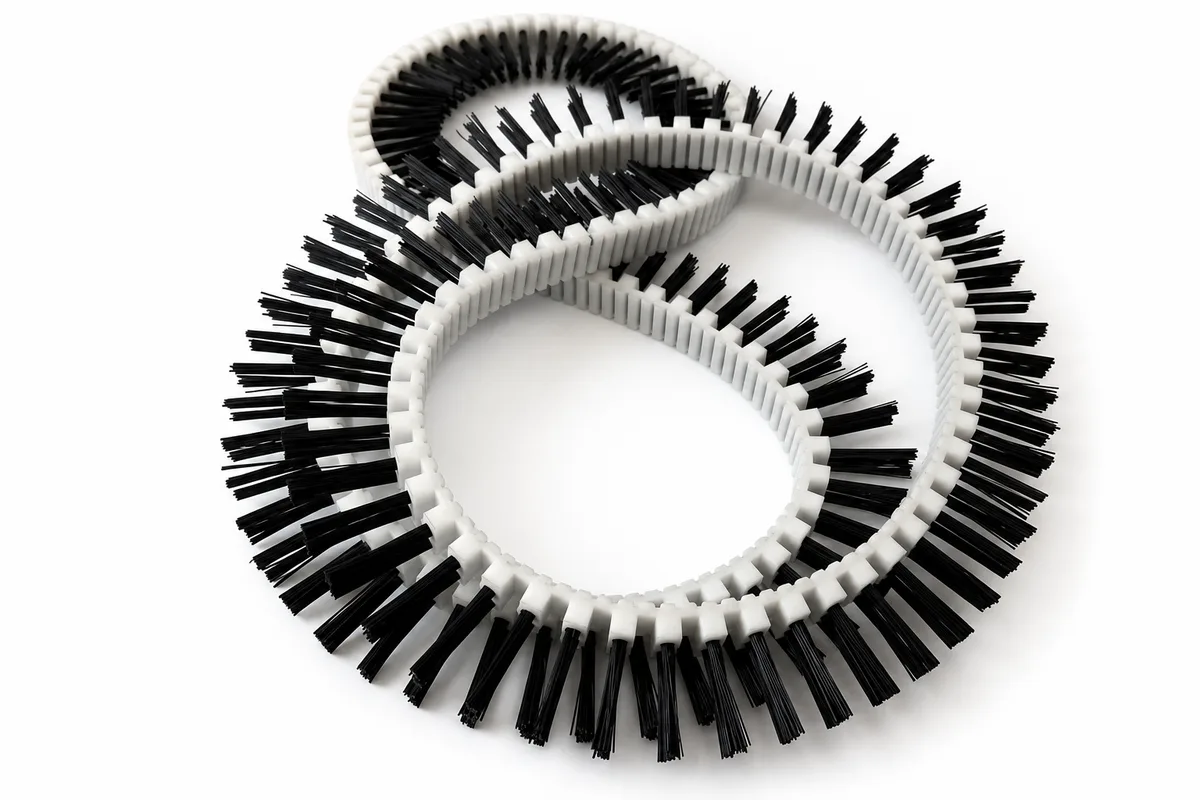
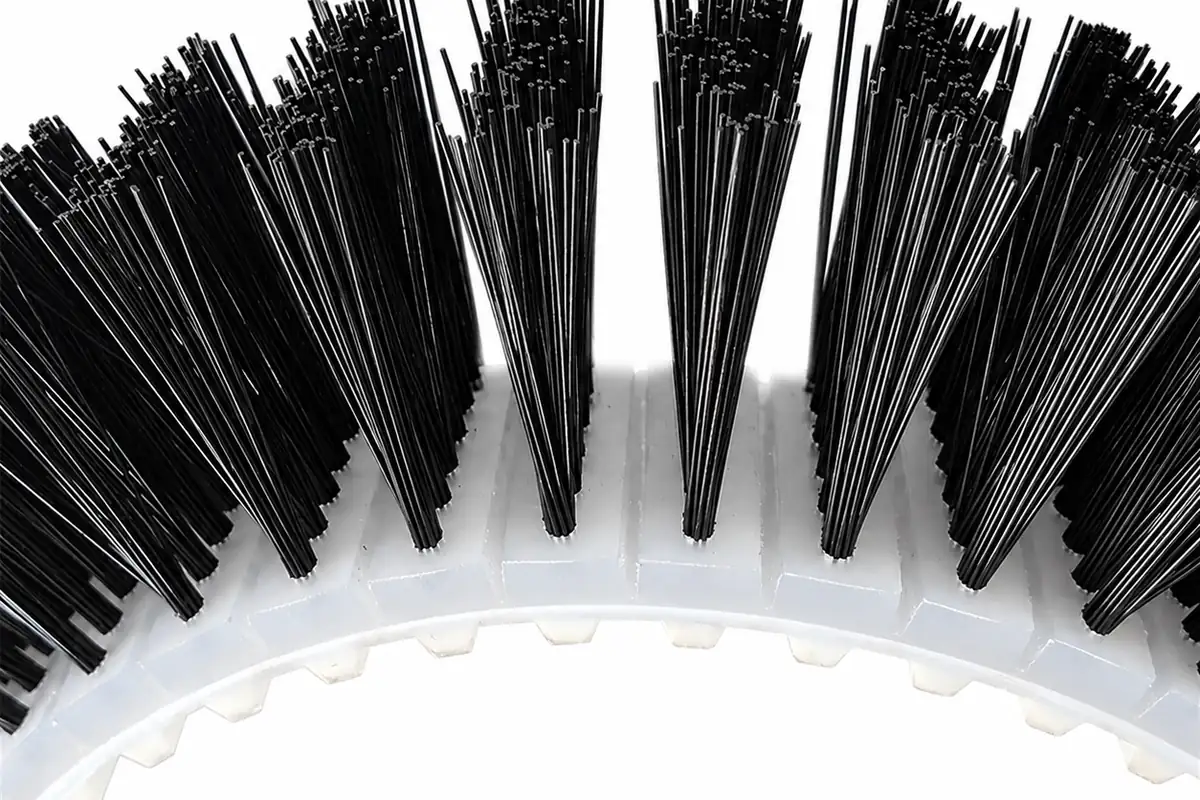
A timing belt brush combines a synchronous or toothed belt with a brush working surface. The teeth engage a matching timing pulley for positive movement, while the filaments convey, support, guide, separate, wipe, or clean the product.
Timing belt, synchronous belt, and toothed belt describe the same broad drive concept.
Use this construction when brush position must remain synchronized with the pulley system, such as indexed feeding, repeatable product spacing, parallel support, or controlled transfer. Positive engagement reduces slip, but positioning still depends on pulley quality, backlash, alignment, belt tension, load, and brush contact.
| Belt-brush type | Typical reason to select it | Main interface to confirm |
|---|---|---|
| Timing / toothed belt brush | Indexed movement or repeatable brush position | Exact tooth profile, pitch, pulley, tooth count, and pretension |
| Flat belt brush | Continuous flexible contact where indexing is unnecessary | Pulley surface, belt width, tracking, and tension |
| V-belt brush | Narrow path or an existing V-groove pulley system | V profile, groove angle, width, and pulley arrangement |
Start With the Tooth Profile and Pulley
The belt and pulley form one meshing system. Tooth pitch is only the distance between equivalent points on adjacent teeth; it does not define the complete tooth shape.
What Do AT5, AT10, and AT20 Mean?
| Profile | Nominal pitch | What it tells you |
|---|---|---|
| AT5 | 5 mm | A small-pitch member of the AT profile family |
| AT10 | 10 mm | A 10 mm-pitch member of the AT profile family |
| AT20 | 20 mm | A large-pitch member of the AT profile family |
Do not choose a profile from a simple “light, medium, or heavy load” rule. For an existing machine, the installed pulley profile normally controls the selection. For a new machine, the designer must consider force, speed, acceleration, duty cycle, tooth engagement, centre distance, pretension, environment, and the selected belt construction.
Why AT5, T5, and 5M Are Not Interchangeable
AT5, T5, and a 5M belt may all have a nominal 5 mm pitch, but their tooth and pulley geometries differ. They are not designed to be interchangeable, even if an incorrect belt appears to enter the pulley groove.
ISO 17396 covers T and AT profile systems. ISO 13050 covers metric curvilinear G, H, R, and S systems. Match the complete belt profile to the corresponding pulley rather than relying on pitch alone.
Direct-Tufted Belt or Brush-Carrier Construction?
Not every timing belt brush is manufactured in the same way. Confirm how the brush face is connected to the belt before copying a sample or approving a pulley layout.
| Construction | Description | What to confirm |
|---|---|---|
| Direct tufting | Filament tufts are installed in the polyurethane belt backing. | Hole position, tuft anchor, tension-member protection, available density, and joint zone |
| Attached brush carrier or rib | A separate rib or carrier is fixed to the back of the timing belt and holds the filaments. | Attachment method, added thickness, flexibility, minimum pulley diameter, and replacement method |
Tuft density is not unlimited. KOTI notes that the available filling area on its toothed belt brush restricts density, while Mink describes a construction using attached ribs to accommodate the filaments. These are examples of different designs, not universal Brushcustom specifications.
The approved drawing should identify the belt and tension-member construction, brush attachment method, hole or rib layout, joint position, and any tuft-free area. Do not assume that a dense pattern can be added without affecting belt flexibility, strength, or pulley clearance.
Specify Pitch Length and Working Dimensions
Timing belt length is normally stated as pitch length, measured along the belt pitch line:
Pitch length = tooth pitch × number of teeth
For example, a 100-tooth AT10 belt has a nominal pitch length of 1000 mm. Do not use the circumference measured over the bristle tips. Tooth count is usually more reliable than measuring the outside of a worn or flexible sample.
A usable drawing should include:
- Belt: exact profile, pitch, tooth count, pitch length, width, backing thickness, and original marking;
- Pulley: matching profile, tooth count, face width, flanges, drive and idler sizes, centre distance, and tensioning travel;
- Brush: brush face width, free trim, overall tooth-to-tip height, number of rows, tuft-hole diameter, row and longitudinal spacing, pattern, edge clearance, and tuft orientation;
- Machine: travel direction, reversing duty, installation orientation, guards, product clearance, and number of parallel lanes;
- Contact: product height and tolerance, nominal interference, acceptable surface marks, and required process result.
For two or more parallel belts, also state whether they must be supplied as a matched set. Pitch length, brush height, tuft phase, shaft timing, and independent tension adjustment can affect how evenly the lanes share the product load.
Select Filament, Trim, and Contact Together
“Nylon bristle” is not a complete specification. Filament grade, diameter, free trim, density, pattern, speed, contact, and environment work together to determine stiffness, recovery, wear, and surface behavior.
| Application condition | Materials to evaluate | Information required |
|---|---|---|
| Gentle support or transport | Fine PA/nylon, horsehair, or another soft fill | Product weight, finish, acceptable marking, humidity, and shedding limit |
| General wiping or cleaning | PA, PP, PBT, or another tested synthetic | Contaminant, moisture, required stiffness, recovery, and wear |
| Wet service | PP, PBT, PA 6.12, or another confirmed grade | Water temperature, detergent, drying, hydrolysis, joint, and tension-member exposure |
| Static-control duty | Documented conductive or dissipative filament | Target resistance, grounding path, humidity, and finished-assembly test |
Define whether the brush should lightly touch, wipe, carry, support, separate, or clean. There is no universal contact percentage for a timing belt brush. Surface-sensitive products should be tested with representative parts at the expected speed and load.
For more material detail, see the industrial brush filament materials guide.
Open-Ended, Welded Endless, or Truly Endless?
| Construction | Meaning | Purchasing question |
|---|---|---|
| Open-ended | Supplied as a length rather than a closed loop | Can the machine clamp or join the belt, and is there enough installation access? |
| Finger-spliced / welded endless | A thermoplastic belt is welded into a loop | What is the joint rating, local stiffness, pitch tolerance, and tuft-free zone? |
| Truly endless | Manufactured as an endless loop without a welded splice | Is the required profile, length, width, cord, and brush-processing method available? |
Do not use “continuous” alone when the joint matters. Ask whether the belt is welded endless or truly endless. As one named reference, Optibelt states that its finger-welded ALPHA V joint reaches at least 50% of the permissible tensile force of the comparable uninterrupted-cord construction. That value is not a universal rating for every brush belt.
Check Pulley Diameter, Alignment, and Pretension
The minimum pulley size must satisfy both the selected base belt and the finished brush construction. Direct tufting, attached ribs, added thickness, welded joints, and back-bend idlers can increase the required diameter. Confirm the drive and idler tooth counts, any reverse bending, brush-to-guard clearance, and the supplier-approved minimum diameter.
Before a loaded trial, confirm that pulley axes are parallel, shafts are aligned, flanges and lateral clearances suit the belt, and enough teeth remain engaged. There is no universal pretension or deflection value: too little can permit tooth climbing, while too much can overload the belt, bearings, shafts, or joint. Use the selected belt supplier’s calculation and measurement method.
For parallel belts, verify pulley timing and provide independent adjustment where required. Replacing only one belt in a worn set can create differences in pitch length, brush height, phase, and load sharing.
Confirm Operating Limits and Special Requirements
A finished timing belt brush is governed by its lowest applicable limit. The belt polymer, tension member, joint, brush attachment, filament, contact load, pulley geometry, temperature, and chemicals must be reviewed as one assembly.
- Speed: KOTI publishes up to 6 m/s for its own toothed belt brush. Treat this as a named product example, not a default rating for another construction.
- Temperature: published PU timing-belt examples often extend to about 80°C, but loaded ranges may be narrower. Perlon gives approximately 80–100°C as the maximum recommended continuous range for many engineering-polymer filaments and about 60°C for PP.
- Chemicals and washdown: provide the exact liquid, concentration, temperature, contact duration, rinse cycle, and drying method. Generic polymer names are not enough for compatibility approval.
- Food contact: document the exact belt, filament, colorant, joint, tuft-retention material, and intended conditions of use. The FDA states that the regulatory status of a food-contact article depends on its individual substances and authorized conditions of use.
- ESD: belt conductivity does not prove that the complete brush assembly dissipates charge. ISO 9563 covers electrical resistance and testing of antistatic synchronous belts; the finished machine still needs a defined grounding path and acceptance test.
- Cleanroom use: polyurethane or low-shedding filament alone does not establish a cleanroom class. Define the required particle limit, operating state, cleaning method, and equipment-level validation.
How to Identify a Replacement Timing Belt Brush
- Photograph all original markings before cleaning or cutting the belt.
- Record the machine manufacturer, model, installation position, and original part number.
- Photograph the belt teeth beside the matching pulley and include a scale.
- Confirm the tooth profile from a marking, drawing, gauge, or supplier identification process.
- Count the teeth and calculate the pitch length.
- Measure the belt, pulley, brush geometry, filament, pattern, and machine clearance.
- Mark measurements that may have changed through wear, stretch, heat, compression, trimming, or contamination.
- Send the least-worn sample together with the drawing and machine photographs.
Do not copy a worn sample literally. A used brush may have lost trim height, density, tuft shape, or effective length. Compare it with the pulley, product height, machine clearance, and any previous drawing or purchase record.
Validate the Sample Before Repeat Production
- Verify profile, pulley fit, direction, and clearance without product load.
- Set pretension using the approved belt method and run at low speed.
- Inspect tracking, tooth engagement, edge contact, joint passage, vibration, and temperature rise.
- Introduce representative products and confirm contact, stability, surface quality, and process result.
- Run the expected speed, start/stop cycle, duty, and environment where safe.
- Record the approved sample ID, drawing revision, materials, dimensions, machine settings, and acceptance criteria.
| Observed problem | Items to investigate |
|---|---|
| Tooth skipping or climbing | Profile, pretension, tooth engagement, load, and acceleration |
| Edge wear or lateral movement | Shaft alignment, pulley flanges, side load, and tracking |
| Uneven filament wear | Contact setting, product-height variation, lane matching, and alignment |
| Product scratching | Filament diameter, stiffness, contact, speed, and trapped particles |
| Joint disturbance or brush shedding | Joint position, local stiffness, tuft retention, pulley size, and operating load |
Service life must be tied to an agreed failure criterion, such as loss of trim, unacceptable product marking, tooth or joint damage, tracking instability, or failure to achieve the required process result.
Timing Belt Brush RFQ Checklist
Send a clear drawing or the least-worn approved sample. Include:
- Belt profile, tooth count or pitch length, belt width, and open or endless construction;
- Brush face, free trim, filament, and tuft pattern;
- Matching pulley, operating speed, brush contact, and any temperature, moisture, chemical, or cleanliness requirement;
- Sample and production quantity.
For a replacement, also include the original marking and machine photographs. Send the available information through the Brushcustom RFQ form. For manufacturing options, review custom belt brushes.
Frequently Asked Questions
Can we reuse the existing timing pulleys?
Often yes, if their exact tooth profile, width, flange arrangement, condition, alignment, and tooth engagement suit the replacement belt. Worn or incorrectly identified pulleys should not be approved from pitch alone.
What limits the maximum tuft density?
Available backing area, belt width, tension-member location, tuft-hole or carrier-rib size, joint position, belt flexibility, and minimum pulley diameter can all limit the pattern. A timing belt brush may not achieve the same continuous surface as a panel or roller brush.
Does tufting affect the belt tension members?
It can if the belt and hole pattern are not designed together. The manufacturer should identify the tension-member construction and approve the tuft or carrier layout rather than drilling an unspecified finished belt.
What determines the minimum pulley diameter?
The base-belt profile and tension member set one limit; brush ribs, tuft geometry, added thickness, weld, and any back bending may set a larger one. Use the finished belt-brush supplier’s approved value.
Should parallel timing belt brushes be ordered as a matched set?
Use a matched set when multiple belts share one product or require synchronized tuft phase and equal height. Replacing a single lane may be possible, but pitch length, trim, phase, wear, and tension must be checked against the remaining belts.
Who determines pulley size and pretension for a new machine?
The machine designer or qualified belt-drive supplier should size the drive from the actual load, speed, geometry, belt construction, and shaft and bearing limits. The brush manufacturer should provide the finished belt-brush dimensions and applicable manufacturing limits.
Begin with the belt and pulley interface, then define how the brush contacts the product. A clear drawing and controlled sample trial are the most reliable way to confirm fit, tracking, surface quality, and repeat-production requirements.