
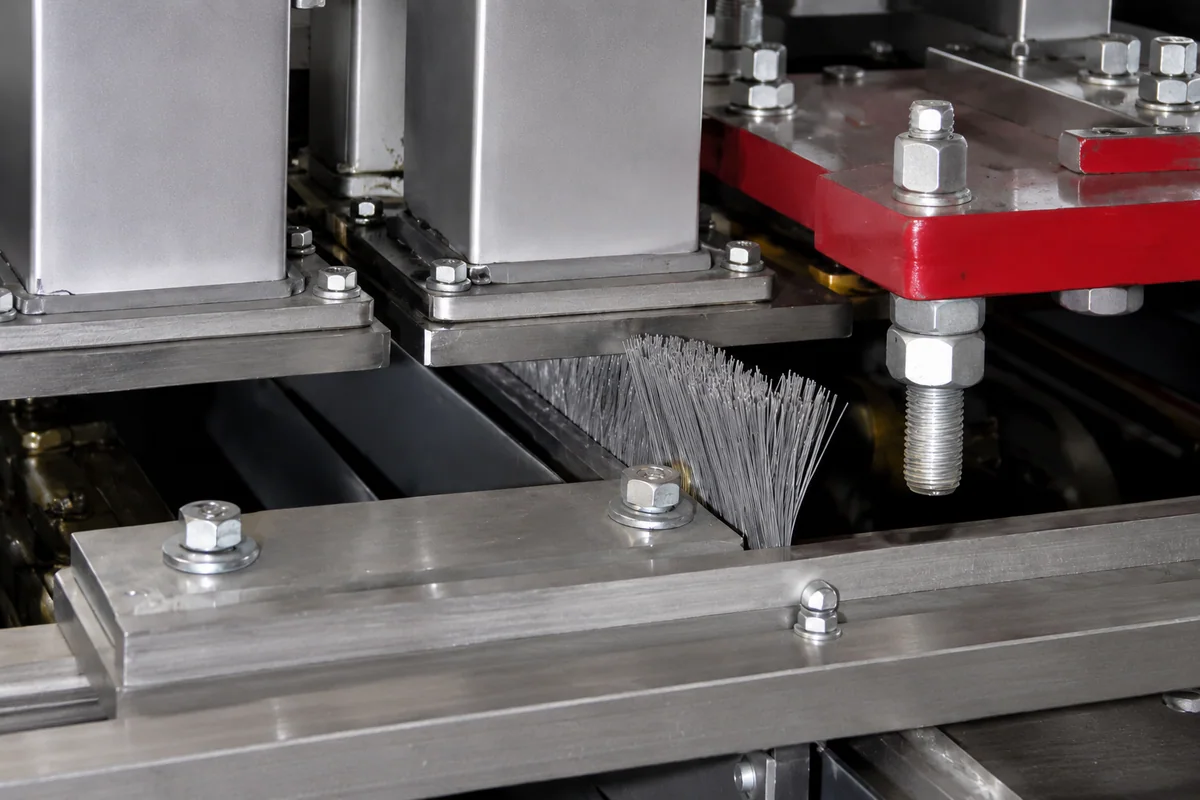
Concrete Block Machine Strip Brushes
Custom replacement strip brushes mounted on the feed drawer or feed box of concrete block, paver, and kerbstone machines. Brushcustom manufactures heavy-duty brush sections from your drawing, worn sample, or holder dimensions for OEM and repeat replacement orders.
Our mixed-fill construction can place PP or nylon bristles on the outside and flat steel wire bristles on the inside. The backing, filament arrangement, and trim are specified for the actual machine position.
Send Your Brush DrawingWhere the Strip Brush Works
In a concrete block machine, the feed drawer or feed box moves material across the mould during filling. A strip brush mounted at the appropriate feed-drawer position contacts the tamper or mould shoes as the mechanism cycles, helping remove adhering concrete residue before the next production cycle.
Buyers may describe this replacement part as a feed drawer brush, feed box strip brush, concrete block machine brush, or brick machine strip brush. Because the same names can refer to different machine positions, we confirm the shoe profile, contact direction, holder, and available clearance before quoting.

What the Brush Helps Remove
During repeated filling and pressing cycles, cement paste, aggregate, and partially set material can collect around the tamper-shoe contact area.
Actual cleaning performance depends on the residue, brush contact pressure, filament arrangement, and machine setup.
Remove adhering material during machine cycling
Keep the tamper or mould shoes cleaner between maintenance stops
Reduce manual cleaning around the defined brush position
Maintain repeatable brush contact across the working width
Built for Concrete Block and Paver Production
This brush position can occur on machines producing concrete blocks, paving stones, kerbstones, and other vibro-pressed concrete products. The brush geometry follows the machine, mould configuration, and contact position; the finished product name alone does not establish interchangeability.

Mixed Filaments and Metal-Channel Construction
PP or nylon provides flexible contact, while flat steel wire gives stronger cleaning action against adhering concrete. Mixed fill can use outer plastic bristles to support and protect inner flat-wire rows. Channel, trim, density, and layout follow the residue, contact direction, clearance, and wear pattern.
We do not treat one backing size or brush height as universal across block machines. If you are replacing an existing strip, send the worn brush or a drawing showing the channel cross-section, overall brush height, working length, and mounting orientation.
OEM and Replacement Orders
We support custom production in repeatable batches for equipment manufacturers, concrete-product plants, maintenance teams, and replacement-parts suppliers. We can review a new-build specification or reproduce the required brush dimensions from an approved sample or drawing.
Replacement brush sections can be supplied alone or pre-mounted in a custom aluminum or steel holder or track, with the layout and mounting confirmed from the drawing or sample.
To prepare an accurate quotation, please provide:
- 01
Machine make and model, if known, and the location of the brush on the feed drawer or feed box
- 02
A drawing or clear photographs of the old brush, holder, and contact surface
- 03
Brush working length and metal-channel width and height
- 04
Exposed bristle length, overall height, and any shaped or stepped trim
- 05
Required outer and inner filament materials, if already specified
- 06
Mounting direction, clearance, and whether you need brush-only sections or a holder assembly
- 07
Prototype quantity and expected batch or repeat-order quantity
Send Us the Existing Brush or Drawing
Tell us where the brush is installed and which machine component it contacts. With the installation position and dimensions, we can help identify whether you need a straight metal-channel strip brush or a different brush construction.
If the brush works directly on the block or paver surface, send a photograph of the station so we can determine whether the application requires a strip brush or a separate rotary finishing brush.