The metal being brushed matters, but its name alone does not determine the abrasive. Identify the actual contact surface—carbon steel, stainless steel, aluminum, copper, or the material and coating of a process roll—before choosing silicon carbide (SiC) or aluminum oxide (Al₂O₃, often abbreviated AO). Then define the burr, oxide or residue to remove and the surface change allowed. Trial SiC when a sharper action is needed for light deburring or surface preparation; include AO when a more controlled finish is the priority. Compare both on the actual surface before approving a specification.
These are starting choices, not guaranteed performance rankings. A brush cleaning a mill work roll and one brushing metal strip directly may need different filaments even if they run in the same line. Grit, filament construction and roller contact can change the result.
First trials by contacted surface and task
Perlon’s abrasive-filament guide lists SiC for metal deburring and surface finishing, and AO for steel and copper polishing. Osborn’s abrasive nylon brush catalog also presents AO as a finishing option for sensitive alloys including aluminum and stainless steel. These are application directions for particular brush products, not a rule that a metal has only one suitable abrasive.
- Carbon or stainless steel: For a defined light deburring or surface preparation duty, SiC can be a first trial; for a controlled finish, include AO. Neither is selected by the steel grade alone. Check the starting surface and permitted change to the base metal; heavy scale may need a different process.
- Aluminum: Consider both SiC and AO. SiC may suit a defined removal duty, while AO may be worth trialing where the surface finish is sensitive. Check whether the brush contacts aluminum strip or a work roll, then compare removal, marking, smearing and the required finish on that specific surface.
- Copper: AO is a reasonable first trial for controlled polishing; compare SiC if the required removal is not achieved. Inspect for scratches and any unwanted residue.
- A process roll rather than the product: Select against the roll material and the deposit being removed. The strip or sheet alloy alone does not define the brush duty.
- An approved replacement: Keep the existing mineral, grit and filament construction if the roller already meets removal, finish and wear targets. If initial cut is adequate but fades during service, diagnose grain wear, nylon wear and contact setting first. A trial of AO may be useful, but mineral-level durability descriptions do not establish that an AO brush roller will last longer in this line.
What changes when the abrasive grain changes?
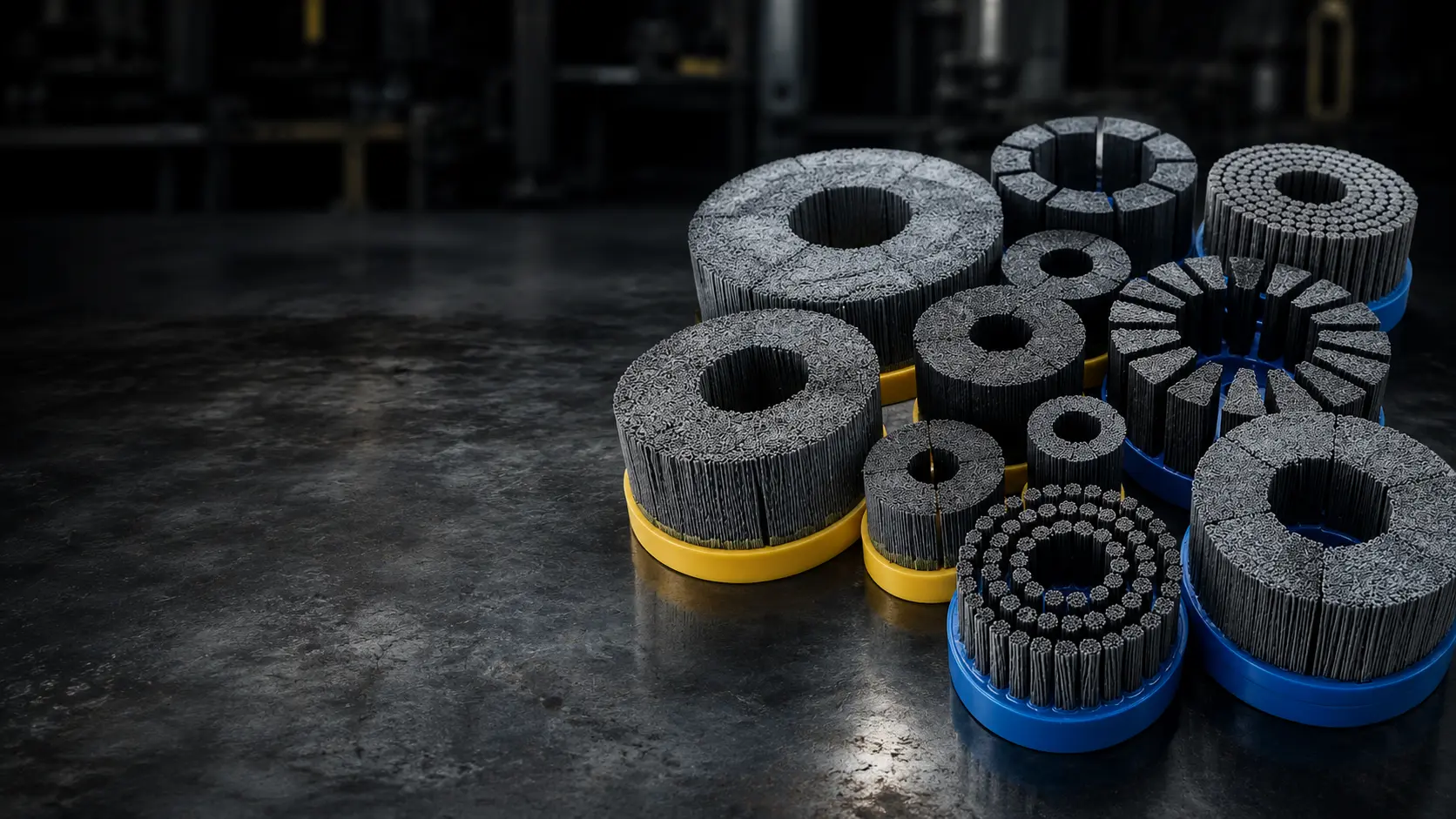
In an abrasive nylon filament, mineral particles are dispersed through a polymer body rather than coated only onto the outside. As the filament wears, more embedded grain can become exposed. Perlon’s abrasive filament range includes both SiC- and AO-filled polyamide products, with available grit and diameter combinations depending on the particular formulation. The carrier polymer, abrasive loading and filament cross-section are therefore part of the specification, not interchangeable packaging around a grain.
In its abrasive products, 3M describes SiC as sharp and relatively fast-wearing, and conventional AO as blockier and more durable. This describes mineral behavior in those products; it does not establish a universal cut rate or service-life ranking for nylon brush rollers. Either mineral can produce a fine finish or unwanted scratches if the grit and contact are wrong.
The terms cutting action and finish also describe different outcomes. A roller can remove a residue quickly yet leave an unacceptable texture; another can leave a good appearance while failing to remove the required burr or oxide. Define both outcomes before selecting the abrasive.
Compare grit within the same filament system
Lower grit numbers generally indicate coarser grain within the same grading system. A coarser grade can increase local cutting action, while a finer grade may be considered when scratch pattern and final appearance matter. The effect still depends on the mineral, abrasive loading and how many filaments contact the surface.
Do not treat a nominal grit number as a complete cross-supplier specification. Confirm the grading designation and the available pairing of mineral, grit, polymer and filament diameter. Coarse particles cannot simply be packed into any thin filament. If grades such as 80, 120, 180 or 320 are available for the proposed construction, they can form a trial range; none is a universal prescription for a particular metal or burr size.
Grit changes should be evaluated against the actual target. For a deburring duty, record the starting and remaining burr condition and any permitted edge change. For surface conditioning, define the acceptable texture or roughness range and check for visible marking. A finer grit will not compensate for a roller that barely reaches the workpiece.
Roller geometry can outweigh the mineral choice
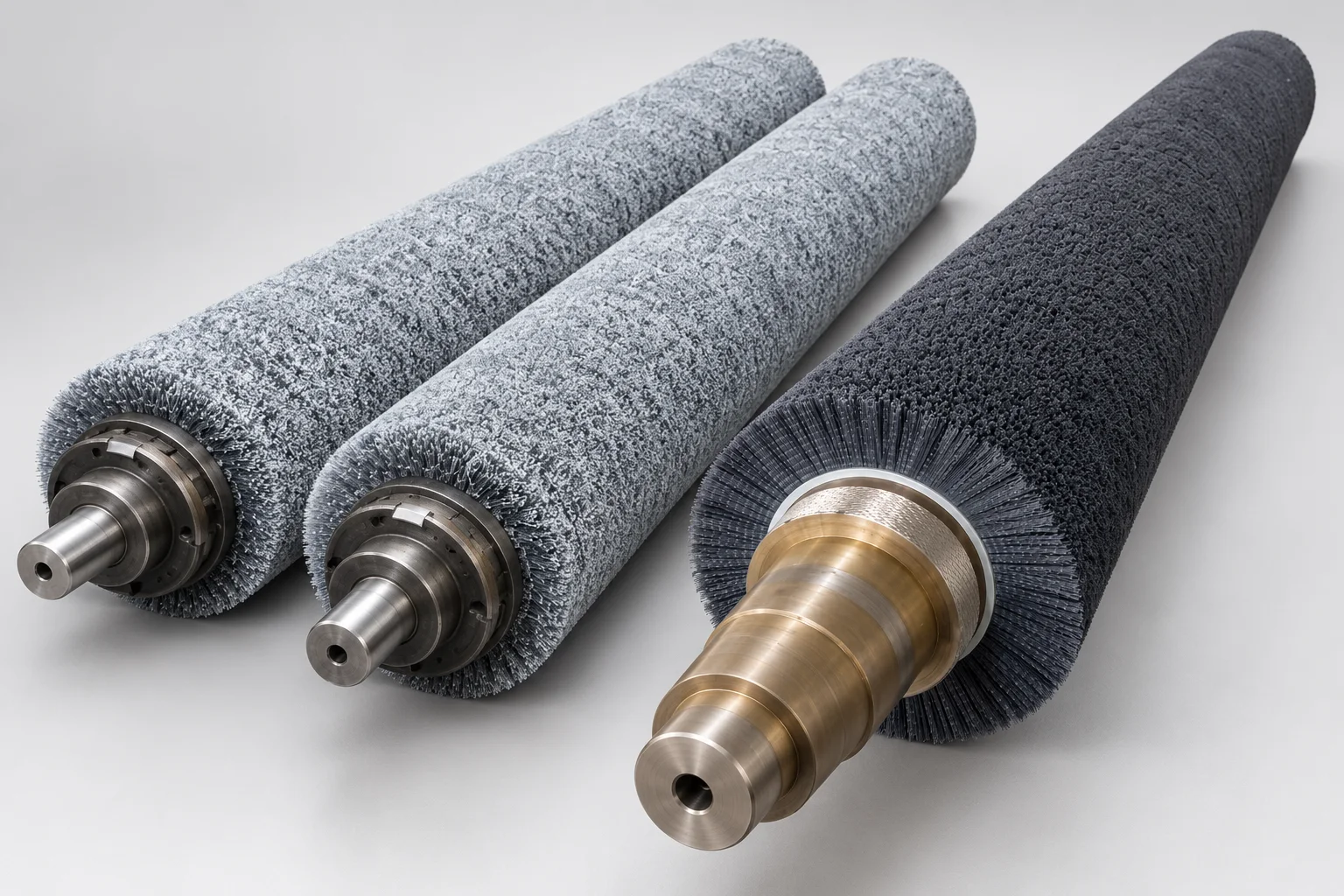
Two rollers built with the same SiC or AO grit may behave differently because their filaments bend differently. A larger diameter or shorter exposed trim generally increases filament stiffness; a longer trim permits more deflection. Fill density changes the number of abrasive contacts across the working face. The roller’s outside diameter, rotational speed, line speed and set penetration govern how often and how deeply the filaments meet the surface.
More interference is not automatically more effective. Excessive contact can increase heat, brush wear and surface damage. Osborn’s abrasive-brush guide illustrates how abrasive particles and filament deflection work together at the contact zone. Its illustrated setup is not a universal penetration setting for a wide industrial roller; establish the setting on the actual machine.
Across a wide strip or sheet, contact must also remain reasonably uniform. Roller runout, shaft deflection, alignment and brush-face variation can create a different finish at the edges than at the center. If a replacement roller changes core construction or outside diameter along with its abrasive grain, a before-and-after comparison cannot isolate the effect of SiC versus AO.
Surface condition and contact position can change the answer
The first-trial directions above must be checked against the actual surface. Alloy hardness and ductility affect how the surface responds to abrasive contact; coatings and oxides can behave differently from the metal beneath them. Annealed, coated and heavily oxidized steel therefore present different removal tasks even when the base alloy is the same. A nylon abrasive roller suitable for a light residue may not remove heavy, adherent scale without an upstream process.
For aluminum and copper, surface marking and residue transfer can become limiting factors. Compare candidates on the specified alloy and finish, then inspect after brushing and any subsequent cleaning. Where contamination limits are strict, consider the complete brush, process fluid and upstream material history rather than attributing all residue risk to the abrasive mineral.
Brush position matters as much as alloy. A roller brushing the product directly may require a cosmetic or functional surface criterion. A roller cleaning a process roll may instead be judged by residue removal and the condition of that roll. These duties should not share a filament specification without review.
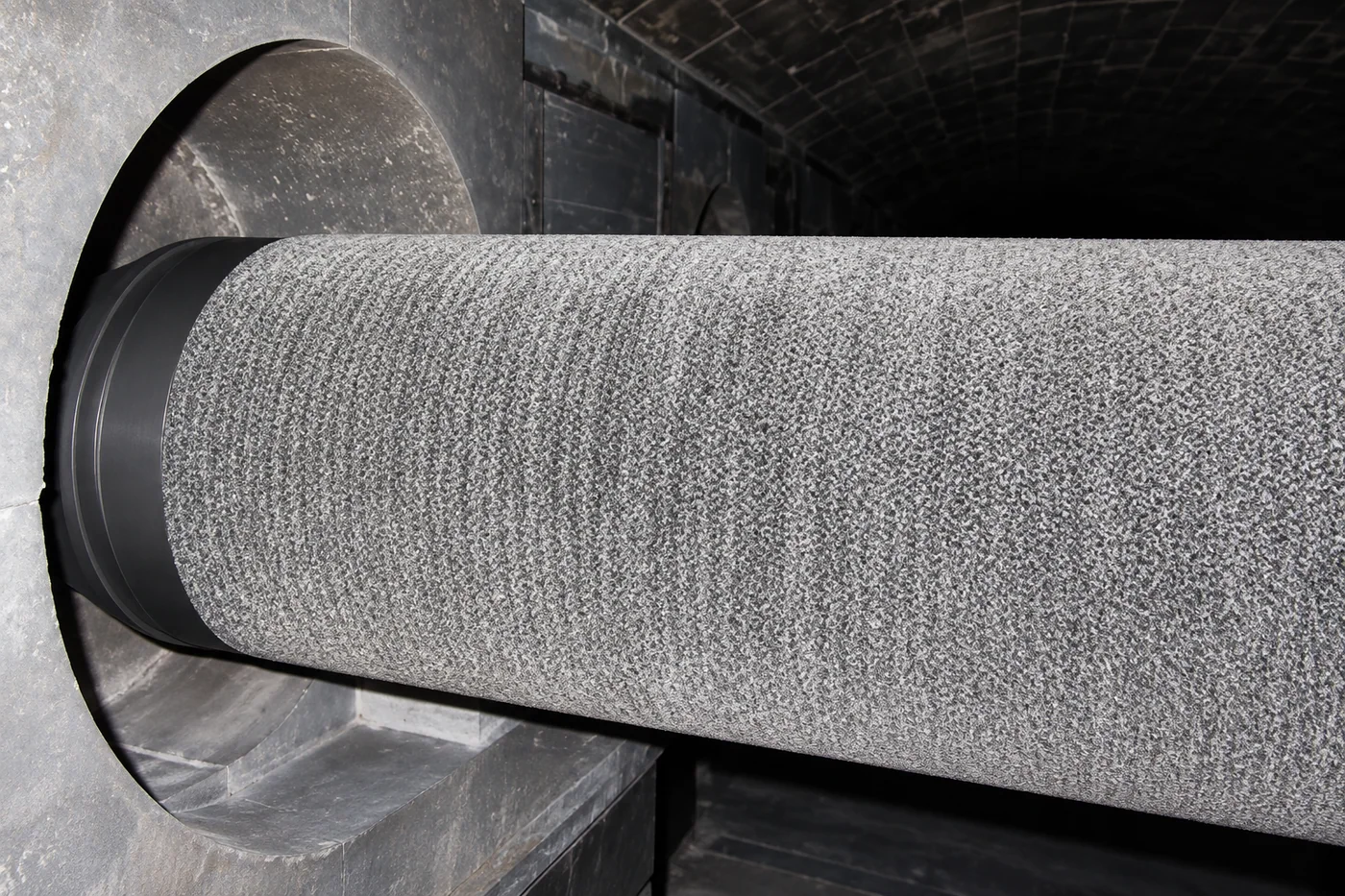
Brushcustom’s aluminum rolling mill replacement case documents an SiC abrasive-filament recommendation after inspection of the existing roller and the installation of 16 replacements. It does not report a controlled SiC-versus-AO trial or measured finish improvement. It shows that SiC can be a project-specific choice in an aluminum rolling application, not that SiC is always the better choice for aluminum.
Account for wet operation and temperature
The mineral may tolerate a process that the polymer filament cannot. In wet cleaning or rolling lines, specify the fluid, concentration, operating temperature and exposure time at the brushing station. Polyamide grade influences moisture uptake and stiffness retention. Perlon lists PA 6.10 and PA 6.12 abrasive filaments for selected wet and dry duties, but the actual formulation and chemical compatibility still require confirmation.
Also separate the line’s highest temperature from the temperature at the brush contact. A roller downstream of a hot section may see a much cooler surface; another may be exposed to heated strip or frictional heat. Do not infer a safe brush temperature from the heat resistance of SiC or AO alone.
Run a comparison that can answer the question
To test an improvement, compare SiC and AO candidates at the same machine position and on the same workpiece, using comparable grit designation, filament size, brush geometry and contact setting where available. When exact matching is impossible, document the differences so the result is not attributed to mineral choice alone.
Before the trial, agree on measurable acceptance criteria: residual burr or residue, surface roughness or appearance, edge change, brush wear and process stability. Record roller speed, line speed, contact depth, fluid and workpiece condition. Inspect samples at the beginning and after a representative running period; a short initial cut test alone may miss changes as the filaments wear.
Choose the mineral that meets the agreed removal, finish and wear criteria in the actual setup. If neither candidate passes, revise the grit or brush contact before assuming a different grain alone will solve the problem.
For a custom abrasive filament brush roller, provide the roller drawing, working-face and shaft dimensions, existing filament specification, contacted surface, process conditions and required finish. State whether the brush touches the product or another machine component. That information allows a meaningful SiC-versus-AO comparison before a replacement or OEM design is approved.