
A steel mill customer needed a replacement spiral brush roller for an Electrolytic Cleaning Line (ECL) processing cold-rolled steel strip. The customer's previous brush rollers reportedly required replacement after about two months, increasing brush consumption and adding maintenance work around the line.
We produced a segmented inner-welded spiral brush roller to the customer's drawing and operating requirements. After installation, the brush remained in normal service for more than three months, exceeding the previously reported replacement interval. Following the successful field result, the customer continued with a follow-up order.
Project at a Glance
- Customer: Steel mill
- Application: Electrolytic Cleaning Line (ECL)
- Processed material: Cold-rolled steel strip
- Brush construction: Segmented inner-welded spiral brush roller
- Field result: Installed and still operating normally after more than three months
- Commercial result: Follow-up order placed after the field trial
The Customer's Two-Month Replacement Problem
The customer's main concern was the service interval of the previous brush rollers. According to the customer, they normally had to be replaced after about two months. More frequent replacement meant higher purchasing costs and additional maintenance activity, with a greater risk of interrupting normal production.
Reproducing the previous brush only by appearance would not address the operating problem. The replacement had to fit the existing shaft, maintain consistent contact across the steel strip, and work under the specified speed, temperature, and alkaline cleaning conditions.
What Affects ECL Brush Roller Life?
Brush roller life is affected by the complete operating system rather than one specification alone. Important factors include:
- Filament material, diameter, density, and elastic recovery
- Contact pressure against the steel strip
- Rotational speed and line speed
- Cleaner chemistry, concentration, and exposure
- Operating temperature
- Brush alignment and dynamic balance
- Internal welding and overall construction quality
For this project, a brown 0.5 mm nylon 66 (PA66) filament was selected for repeated contact in the customer's steel-processing application. The material choice was reviewed together with the specified fill density, temperature, chemical environment, construction, and dynamic-balance requirement.
Confirmed Project Specification
- Brush type: Inner-welded spiral roller brush
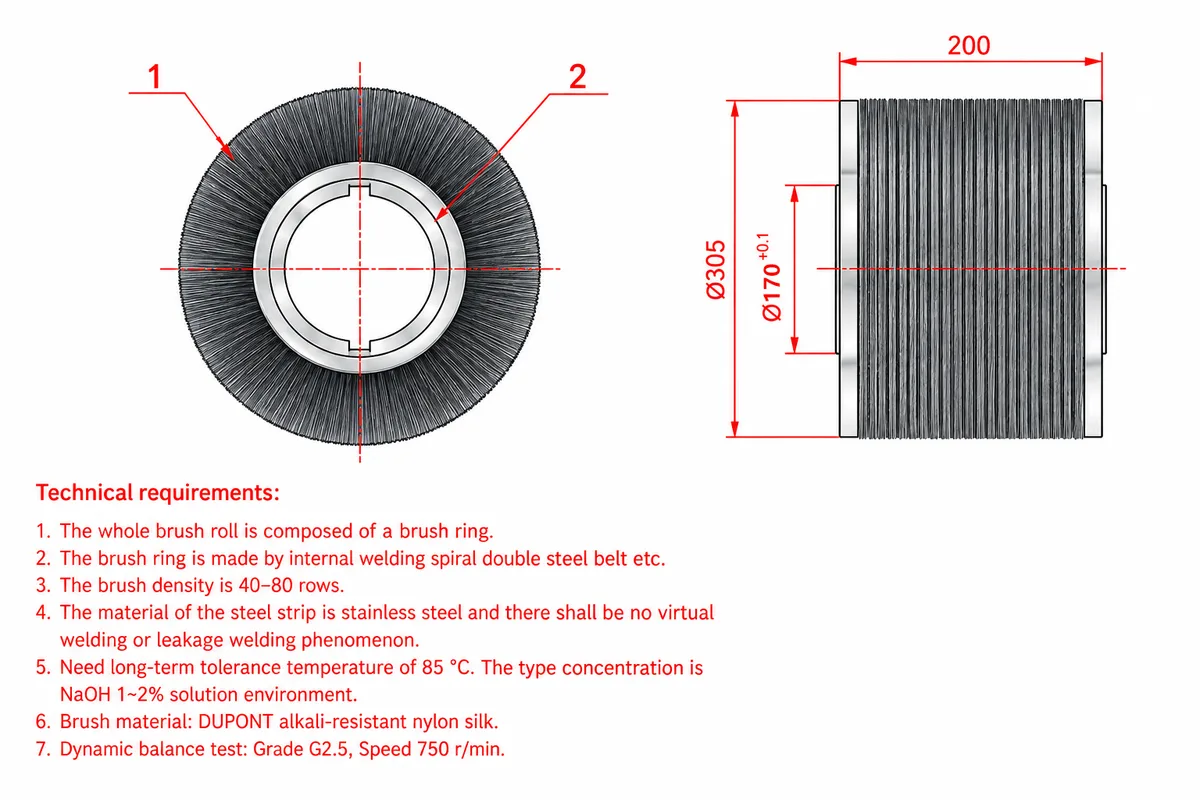
- Outside diameter: 305 mm
- Inside diameter: 170–172 mm
- Assembled working length: 1,600 mm per set
- Section length: 200 mm
- Sections per set: 8
- Filament: Brown nylon 66 (PA66) for the steel-industry application
- Filament diameter: 0.5 mm
- Specified brush density: At least 48%
- Specified dynamic balance grade: G2.5
- Test speed: 750 r/min
- Customer-specified maximum temperature: 85°C
- Process environment: Alkaline cleaning
These figures describe this ECL project only. Dimensions, filament grade, density, speed, balance, temperature resistance, and chemical compatibility must be reviewed for each production line.
Segmented Inner-Welded Construction
The replacement brush consisted of eight 200 mm sections installed side by side on the customer's existing shaft, giving a total assembled working length of 1,600 mm. The brush strip was formed into a spiral inside each section and welded internally to the supporting structure.
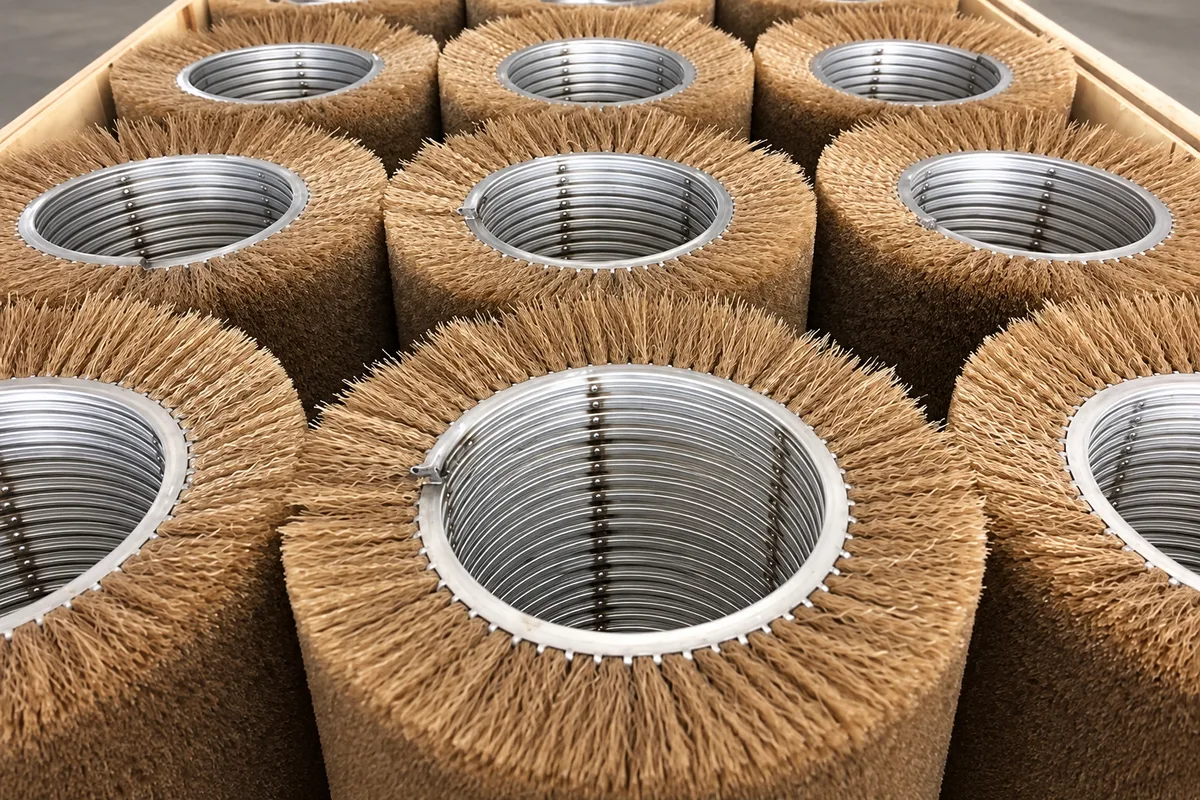
This segmented format allowed the working face to be built around the existing shaft arrangement. It also made the section dimensions, fill consistency, internal welds, and assembled alignment important production controls. More information about this construction is available on our custom spiral and coil brush page.
Sample Production and Installation
After the technical requirements were confirmed, sample brush sections were produced to the customer's drawing. Production checks focused on the outside and inside diameters, consistent section length, filament density, internal welded joints, alignment after assembly, and the specified dynamic-balance requirement.
The sample was then installed on the customer's existing shaft and placed into service on the ECL. Testing the brush in the actual line allowed the customer to evaluate fit, contact, cleaning performance, and wear under the real alkaline environment.
More Than Three Months in Operation
At the latest customer feedback point, the installed spiral brush roller had been operating normally for more than three months. It had already passed the customer's reported two-month replacement interval for the previous brushes.
This is a recorded operating checkpoint, not a universal service-life guarantee. Final brush life still depends on line speed, contact pressure, cleaner chemistry, temperature, alignment, maintenance, and the condition of the processed strip.
Follow-Up Order After the Field Result
After the installed brush passed the field evaluation, the customer proceeded with a follow-up order for six complete sets. Each set contains eight sections, so the order covered 48 individual spiral brush sections manufactured to the confirmed project specification.
The repeat order provided a practical basis for reproducing the approved dimensions, filament, density, welded construction, and assembly arrangement for the customer's ECL.
Information Needed for a Similar ECL Brush
For a replacement project, provide the existing brush drawing or a measured sample together with the brush position, strip material, residue to be removed, OD, ID or shaft details, working length, section layout, filament, rotation direction, operating speed, line speed, contact pressure, cleaner chemistry, temperature, current service interval, and observed wear condition.
These details allow the construction, filament, shaft fit, balance requirement, and operating limits to be reviewed as one system before production.