
Upgrading an existing data center for direct-to-chip (DTC) liquid cooling introduces more than new coolant distribution units (CDUs) and piping. Cooling lines must be routed alongside power and network cables, often through cabinets, equipment openings, and existing infrastructure — and as Chatsworth Products notes in its guide to liquid cooling retrofit challenges, constrained piping pathways and cabinet compatibility are among the most common obstacles, not the CDU purchase itself.
These changes create practical questions: Where should cables and coolant pipes enter? Which openings affect airflow? What type of sealing is required? And can installation proceed without disrupting operating equipment? The answers depend on the location and function of each penetration — and different openings require different treatments.
| Opening Type | Primary Concern | Typical Treatment |
|---|---|---|
| Rack cable entry | Air bypass, cable access, maintenance | Rack brush panels |
| Cabinet / enclosure openings | Non-standard cutouts, long gaps | Metal-channel strip brushes |
| Raised-floor cable cutouts | Plenum air leakage, retrofit around live cables | Brush grommets (incl. split types) |
| Coolant pipe / hose penetrations | Leakage, movement, condensation, fire & structural requirements | Engineered mechanical penetration systems |
1. Identify Existing Cable and Pipe Routes Before Installation
Liquid cooling retrofits must work within the constraints of the existing facility. Before introducing new piping, contractors should review routing space, cable trays, rack layouts, overhead structures, and underfloor pathways.
The Open Compute Project’s Data Center Liquid Distribution Guidance & Reference Designs (Rev 1.0) sets out planning considerations for pipe routing: future equipment expansion, maintenance access, and pipe movement — thermal expansion, vibration, and building displacement can all affect connection reliability, mounting design, and flange performance. Key checks include:
- Available space for supply and return piping
- Existing power and network cable routes
- Clearance around cabinets, cable trays, and other equipment
- Access to valves, fittings, manifolds, and CDUs
- Structural support and anticipated future expansion
In operating data centers, installation sequencing also matters: new pathways may need to be introduced without disconnecting existing IT equipment. A slightly longer piping route that preserves serviceability or deployment sequencing may deliver more operational value than the shortest path.
2. Check Cable Entry Openings in Server Racks and Cabinets
Many liquid-cooled AI installations still require power, networking, monitoring, and control cables — and, as covered in our earlier article on airflow in liquid-cooled facilities, a significant share of rack heat may still leave the room as air. Cable-entry openings may sit in rack-mounted panels, cabinet roofs, bases, or side panels. Where an opening crosses an airflow boundary, unused space around cable bundles becomes a bypass path.
Custom rack brush panels cover these openings while retaining access for cable installation and maintenance. For non-standard cabinet cutouts, metal-channel strip brushes can be manufactured to specified backing profiles, filament heights, section lengths, and mounting holders.
Before selecting a brush assembly, confirm:
- Opening dimensions and mounting position
- Cable bundle size and connector clearance
- Whether the cables are already installed
- Required brush configuration and available mounting space
- Whether the opening forms part of a meaningful airflow boundary
A brush entry is not automatically airtight. Its effectiveness depends on the installed geometry, cable fill, brush coverage, and the surrounding enclosure.
3. Review Raised-Floor Openings Where Air Cooling Remains
Some existing facilities use raised floors as supply-air plenums and will continue to do so for conventional or partially air-cooled equipment after a retrofit. Unsealed cable cutouts let conditioned air escape from the plenum before reaching equipment intakes. The US ENERGY STAR airflow management guidance identifies floor grommets and other cable-opening treatments as practical measures against bypass airflow.
For existing cable installations, split brush grommets can be fitted around connected bundles without disconnection — Chatsworth Products and Upsite Technologies’ KoldLok split grommets are established examples of two-piece designs intended for retrofit installation.
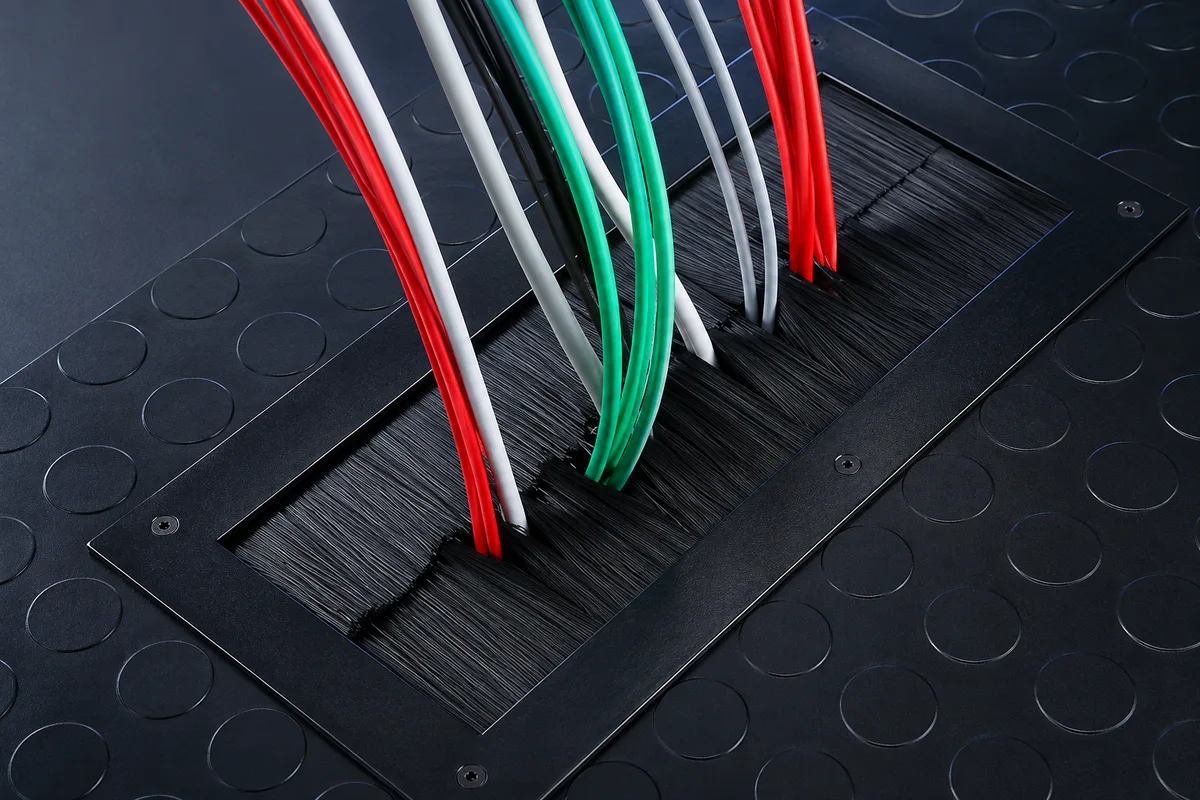
Raised-floor grommets are not universal solutions, however. Floor construction, cable arrangement, load requirements, and any applicable fire-resistance rating must be checked — and in facilities without an underfloor plenum, the airflow benefit of sealing a floor opening may be negligible.
4. Treat Coolant Pipe and Hose Penetrations Separately
Cooling pipes and flexible hoses introduce requirements that ordinary cable entries do not. Depending on the architecture, supply and return lines may run overhead, beneath a raised floor, or through cabinet openings, and must accommodate operating pressure, temperature changes, vibration, and maintenance access. Before finalizing a penetration, review:
- Pipe or hose diameter, including insulation and fittings
- Required clearance and movement allowance
- Hose bend radius and connector access
- Support points and abrasion protection
- Condensation risk and insulation requirements
- Leak detection, drainage, and containment provisions
Vertiv’s liquid cooling guidance highlights pipe routing and leak protection as central to integrating liquid cooling into existing facilities.
A conventional brush strip is not a liquid-tight pipe seal. Where a coolant pipe passes through a cabinet or building element, the appropriate sleeve, edge protection, or engineered mechanical sealing must be selected for the installation. If cables and coolant lines share a cabinet opening, evaluate their routing and protection requirements separately — never assume a brush assembly is suitable for direct contact with coolant hoses.
5. Confirm Fire-Rated Wall and Floor Penetrations
Where cables, conduits, or cooling pipes pass through fire-resistance-rated walls or floors, the penetration must be protected per applicable building and fire requirements. Firestop systems are tested as complete assemblies under UL 1479 and its harmonized equivalent ASTM E814 — meaning the rating applies to the specific wall or floor construction, penetrant type and size, and annular space, not to a sealant product in isolation. UL Solutions’ Firestop and Joint Application Guide provides selection and compliance guidance for code officials and contractors.
The practical consequence: adding cables, changing pipe sizes, or altering annular gaps after installation can take the penetration outside its tested system. Ordinary brush panels, brush grommets, and industrial strip brushes must not be substituted for an approved firestop system — and a flame-retardant filament or plastic component does not establish a fire-resistance rating for the complete penetration.
6. Check Maintenance Access and Future Modifications
Liquid cooling retrofits often occur in phases, with existing air-cooled equipment remaining operational. Penetrations should therefore be reviewed for future maintenance, not only initial installation:
- Can cables be added or removed without replacing the entire entry assembly?
- Can technicians access coolant fittings and isolation valves?
- Will removing a cabinet panel disturb existing cables or hoses?
- Is space available for future equipment changes?
- Can sealing components be inspected and replaced independently?
Split or accessible brush configurations are useful where operational cables cannot be disconnected. For coolant piping, modifications must follow the cooling-system manufacturer’s procedures and the facility’s approved maintenance requirements.
7. Verify the Installation Before Handover
Final inspection should confirm each penetration meets its intended function:
- Cable-entry brush assemblies: mounting security, coverage around bundles, edge protection, accessibility
- Airflow performance: pressure differences, equipment inlet temperatures, and unwanted air paths, measured before and after — a visual check alone does not establish a cooling-efficiency improvement
- Coolant piping: approved pressure and leak tests, connection inspection, monitoring, and maintenance documentation
- Fire-rated penetrations: system identification, installation records, and inspection per project requirements
Document these checks separately — treating all penetrations as one sealing category is how the wrong component ends up in the wrong opening.
Conclusion: Select the Treatment According to the Opening
The correct treatment depends on what passes through the opening and what the opening must achieve. Rack brush panels and custom metal-backed strip brushes can cover suitable cable-entry gaps while maintaining access for ongoing equipment changes; coolant pipe penetrations and fire-rated assemblies require their own engineered solutions. The most practical approach for contractors is to identify each penetration, confirm its requirements, and select the component before installation.
Custom Brush Components for Data Center Retrofits
Brushcustom manufactures drawing-based rack brush panels and metal-channel strip brushes for cable-entry and equipment-enclosure applications. Send us your opening dimensions, mounting details, cable arrangement, material requirements, and estimated quantity for a custom manufacturing review.
Explore Data Center Brush Solutions | Request a Custom Quote