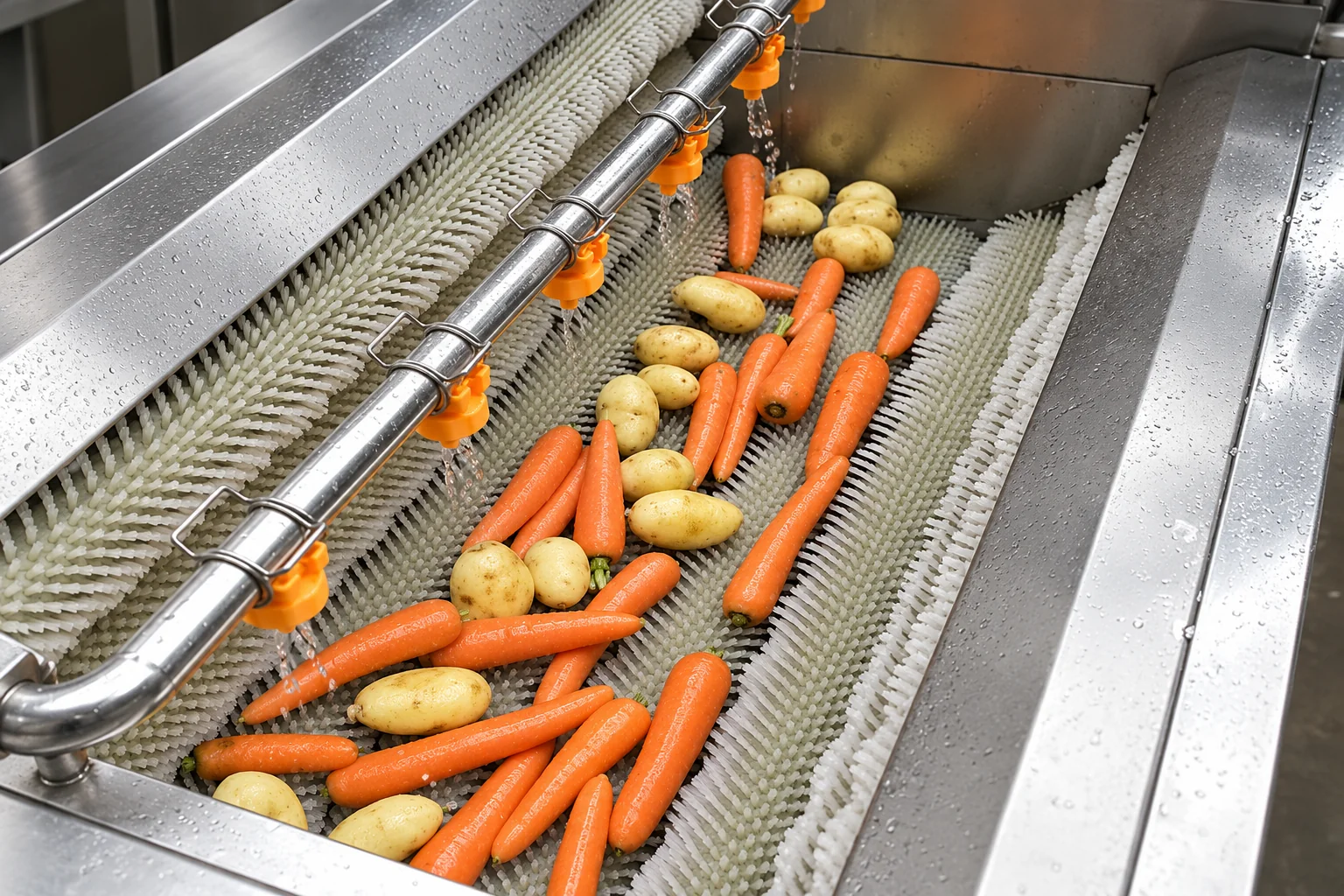
A washing roller brush must remove the required surface soil without causing unacceptable scuffing, skin loss, or bruising. In a brush-bed washer, the rotating rollers also support and turn the produce so that different surfaces meet the filaments and rinse water. Selecting the brush therefore means selecting its role in the complete roller bed, not just its filament material.
Begin with the produce, the residue to remove, and the desired result. A setting suitable for soil-covered potatoes may be too aggressive for ripe tomatoes. Even brushes made with the same filament can behave differently when the trim profile, roller spacing, rotation speed, and product loading change.
Match brush contact to the produce and soil
Delicate or easily marked produce needs controlled contact. Finer, more flexible filaments may reduce brushing intensity, but softness alone cannot prevent damage. Product size, maturity, loading depth, residence time, and the way adjacent rollers turn all affect rubbing and impact. Apples and citrus may tolerate different washing or polishing conditions depending on variety and process stage; neither should be assigned one universal brush specification.
Root vegetables such as potatoes and carrots may arrive with heavier or more adherent soil. They may need a different filament, more contact time, better water application, or an upstream washing stage. Increasing brush stiffness without checking the process can remove skin as well as soil. Washing and peeling are separate duties: a washing brush should meet the specified cleaning result without unintended surface removal.
For a line that handles several crops, define the acceptable cleaning and damage limits for each product. A single brush bed or speed setting should not be assumed suitable across the full range without trials using representative produce.
Choose the roller’s working-face profile
The surface contour changes how produce is supported and moved between adjacent rollers. Profile selection must be made together with roller spacing and rotation direction.
Parallel or straight trim provides a relatively uniform working diameter along the roller. It is a practical starting point when the machine needs even contact rather than a shaped movement pattern. Uniform trim does not, by itself, guarantee that irregular produce will turn consistently.
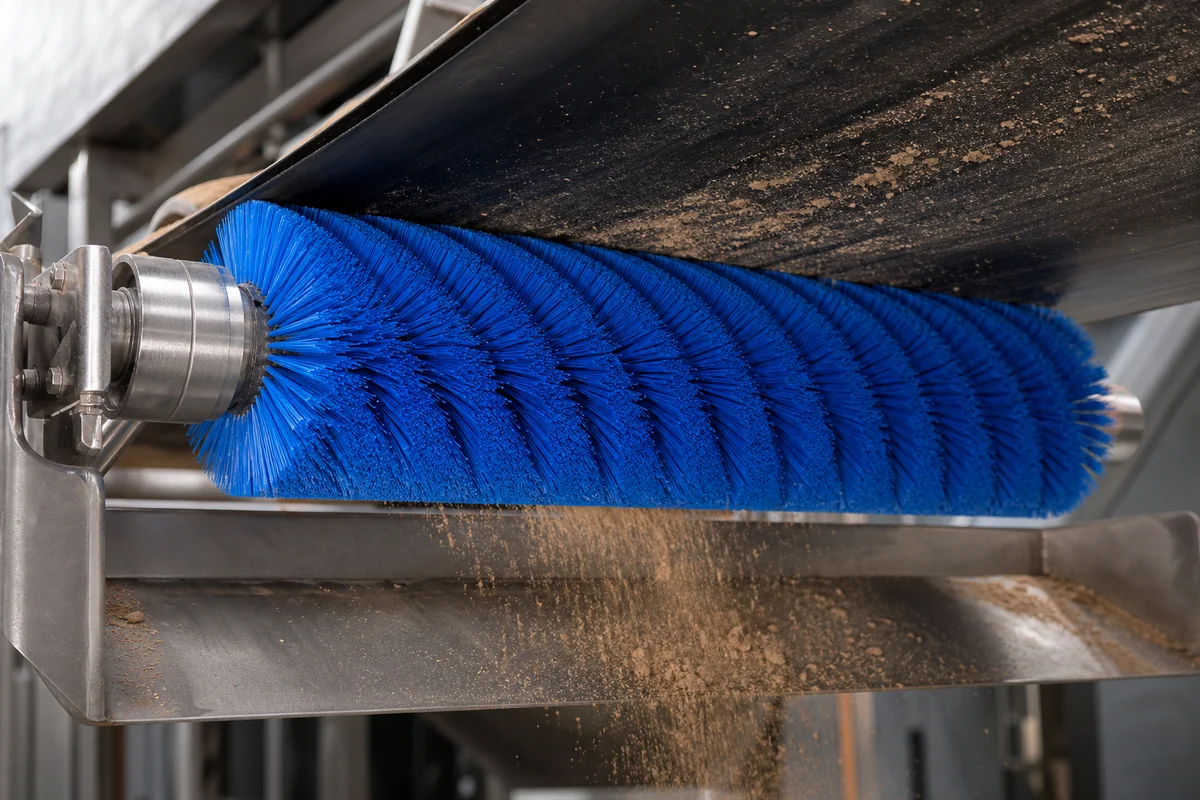
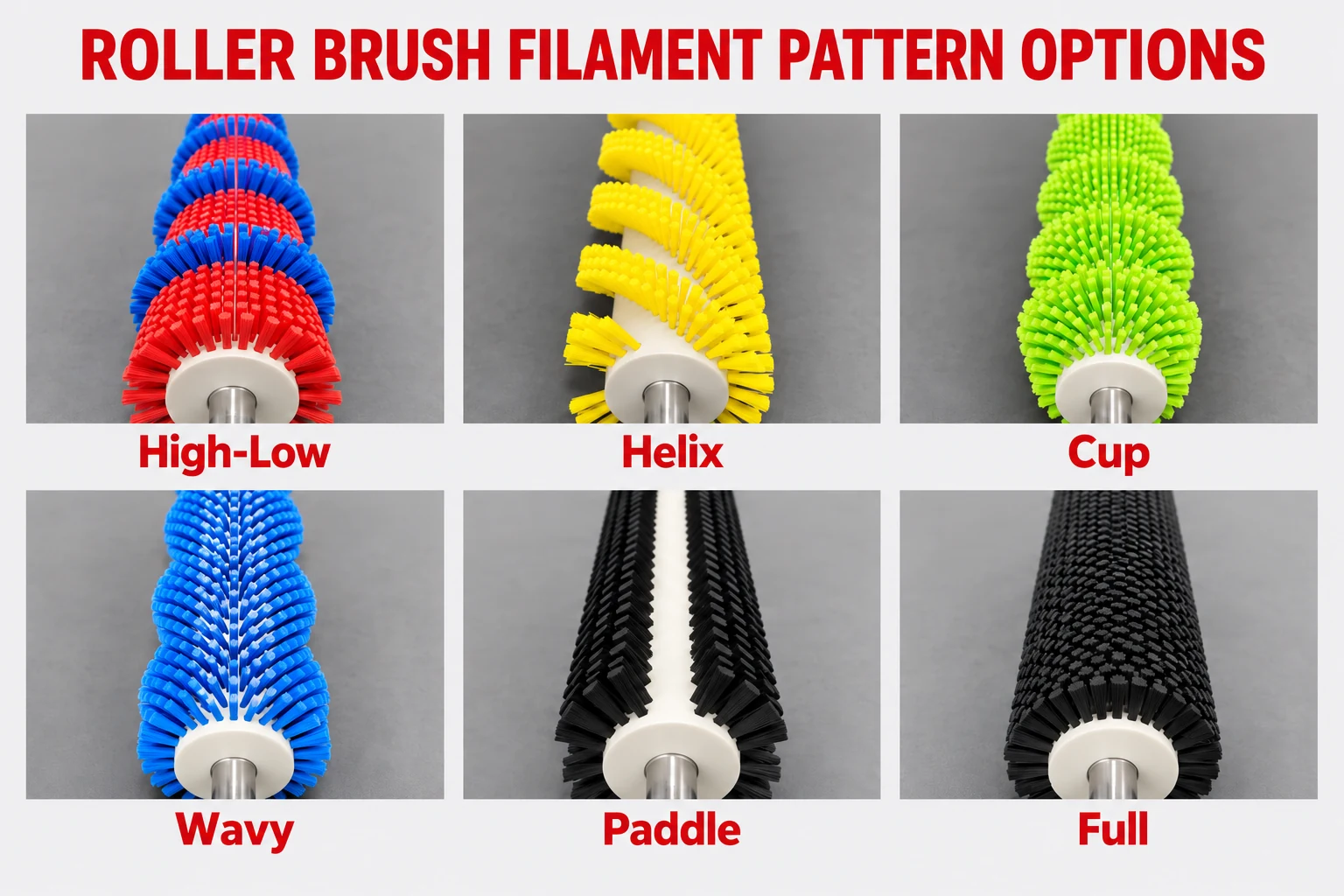
Spiral-cut trim has helical grooves cut into the filament surface. Depending on groove hand, roller rotation, and bed layout, the contour can influence how produce turns and travels along the rollers. Some equipment uses left- and right-hand spiral cuts in a defined sequence. That sequence belongs to the machine design; it should not be copied into another washer without checking its movement effect.
Scalloped or high-low trim alternates raised and recessed areas along the brush face. It can be considered where the equipment needs to influence product rotation or limit sideways migration. The effect depends on produce size and shape, roller pitch, and the contour of neighbouring brushes. A scalloped profile is not automatically gentler or more effective than a straight one.
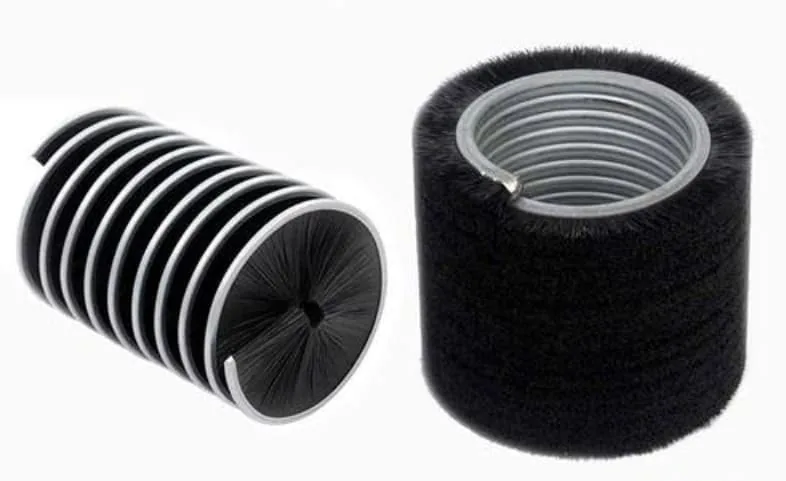
A spiral-cut brush is also different from a spiral-wound brush. Spiral-cut describes the finished filament contour. Spiral-wound describes a construction in which strip-brush material is wound around a core. Either construction may be given a specified finished profile, subject to manufacturing feasibility.
Set spacing, speed, and water delivery together
Roller outside diameter and shaft-centre spacing determine how produce sits between brushes. A gap that is unsuitable for smaller items may let them settle too deeply or move inconsistently; another arrangement may create excessive contact with larger items. Review the intended produce size range, the working filament diameter, and the loaded position before fixing the roller layout.
Speed affects product rotation, contact frequency, and time in the washing section. More speed does not automatically mean better cleaning; it can also increase rubbing or impact. Check the direction and speed of adjacent rollers and how product advances through the bed. A trial should assess both soil removal and visible or delayed product damage.
Water sprays help loosen and carry away soil while the brushes make contact. Nozzle coverage, drainage, and access for cleaning matter because released material should leave the brush bed rather than remain trapped in the filaments. Where a process uses detergents or sanitizers, the brush materials and cleaning procedure need review for the actual exposure.
Specify construction and replacement fit
Produce washers may use tufted rollers, spiral-wound rollers, or modular sections. Tufted construction retains filament bundles in a drilled core; a spiral-wound construction uses wound brush strip; modular sections build the working length around a compatible shaft. Choose the construction that matches the machine’s drive, mounting, cleaning access, and replacement method rather than assuming these forms are interchangeable.
For a replacement, confirm finished outside diameter, working length, core or shaft interface, filament trim, fill pattern, and any shaped profile. A brush may fit the shaft yet change produce movement if the filament or contour differs from the approved design. A worn sample can help identify construction and mounting, but its current diameter may not represent the original working size.
If the brush contacts food, confirm the material and documentation requirements for the intended market and use. “Food grade” is not a blanket property of nylon or of the complete roller; see the separate food-processing brush materials and hygiene guide for that review.
Information to send for a custom washing roller
Send the produce type and size range, soil or surface residue, required washing result, and any limit on marking or skin loss. Include the roller-bed drawing, working length, finished diameter, shaft or core dimensions, rotation direction and speed, proposed filament and trim, water or chemical exposure, and required quantity. For a shaped brush face, provide the contour drawing and its orientation in the machine.
Brushcustom manufactures custom cylinder and roller brushes for drawing-based OEM and replacement projects. The proposed construction and working profile can be reviewed against your equipment specification and, where needed, a sample trial. For the wider application range, see food-processing industrial brushes. Submit the drawing or existing sample through the RFQ form for a manufacturing review.