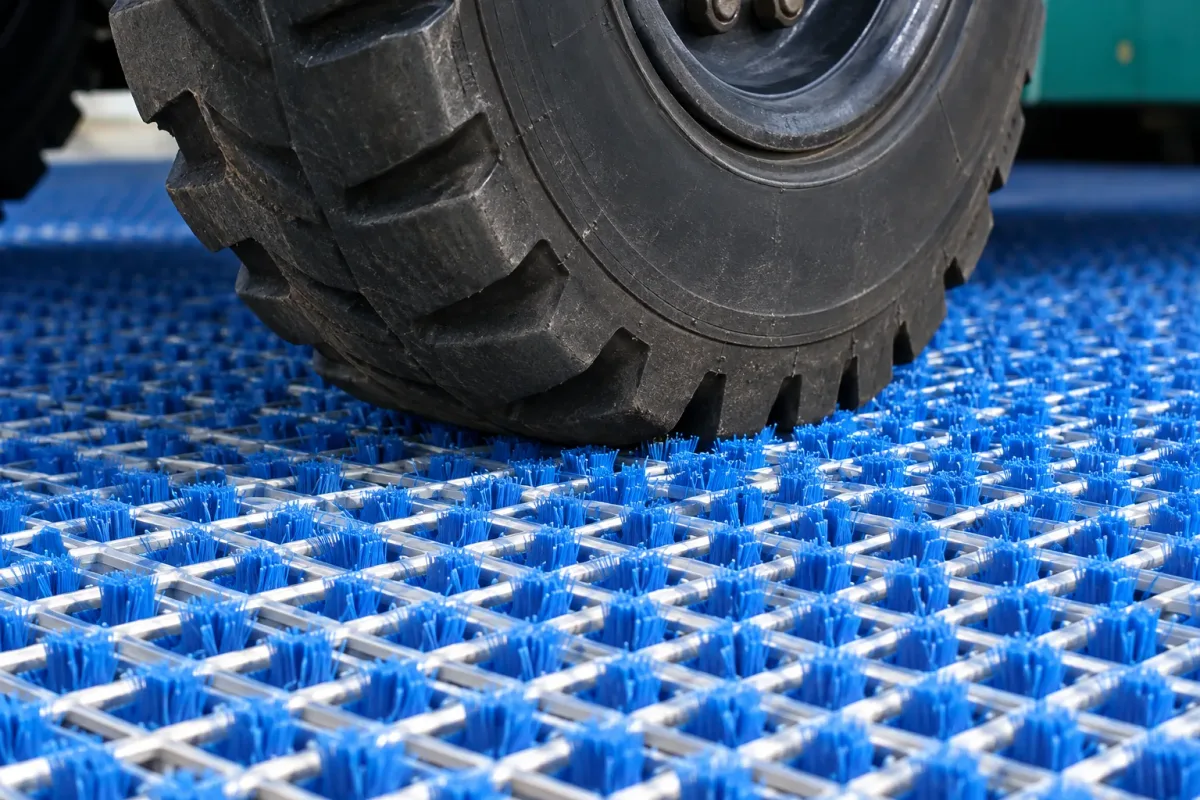
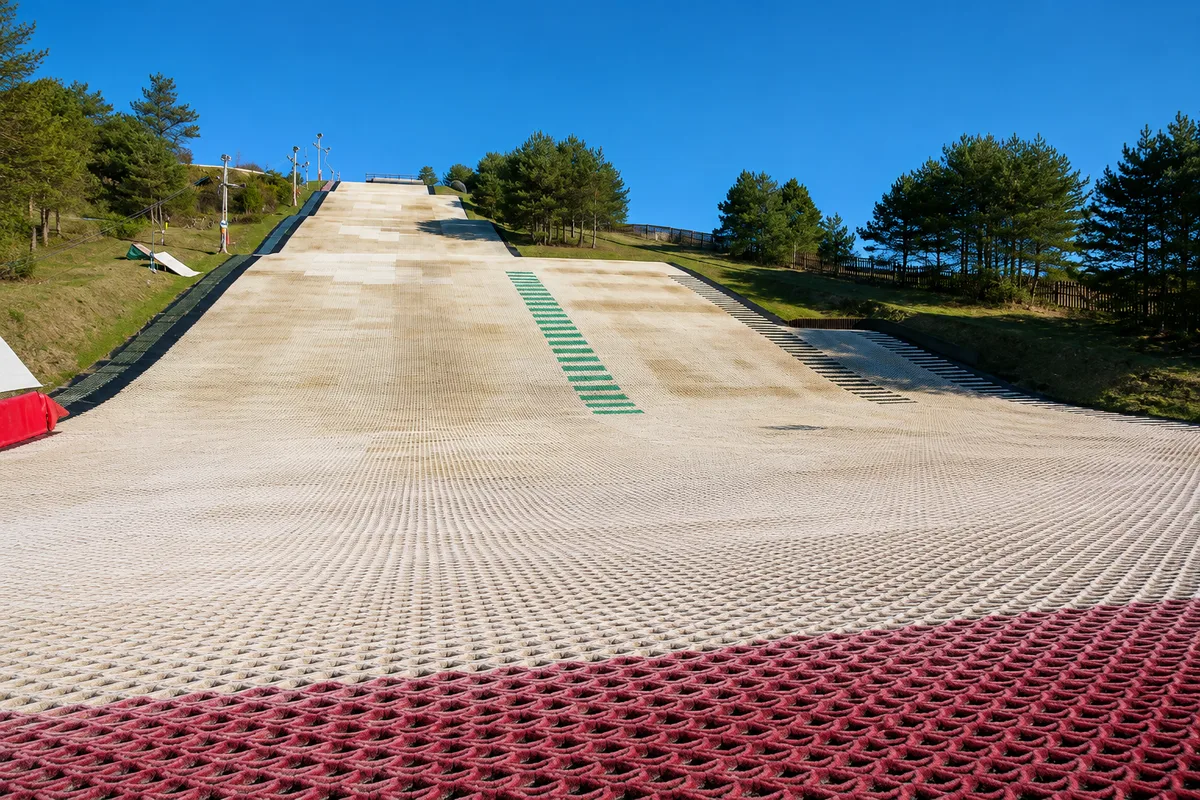
Inspect dry ski slope bristle mats for loose sections, damaged connections, sharp or protruding metal, worn bristles and uneven surface height. Isolate hazardous areas for assessment before normal use resumes. For replacement, establish the cause of damage and check how the new mats will join the retained surface. A similar diamond pattern does not establish interchangeability.
Brushcustom manufactures custom dry ski slope bristle mats to customer-confirmed drawings, reference samples and project specifications.
Why Regular Bristle-Mat Inspection Matters
A dry ski slope is a continuous operating surface. A small damaged section can affect more than appearance: it can create a raised edge, expose a connection, change ski contact or allow adjacent sections to move.
The UK Health and Safety Executive’s ski-slope guidance recommends inspecting slopes at least daily for damage and debris, following the surface manufacturer’s instructions for maintenance and repair, and keeping useful records.
Plan additional inspections around the surface instructions, operating hours, user traffic, weather and reported problems. Main fall lines, turning zones, lift entrances, tow tracks and stopping areas may need closer attention because wear is rarely distributed evenly.
What Should Be Inspected?
Use a consistent route across the slope and record findings by zone.
| Inspection area | What to look for | Why it matters |
|---|---|---|
| Bristles | Missing, broken, flattened, shortened or contaminated fill | Can change support and sliding consistency |
| Mat surface | Low spots, raised sections, waves or visible differences between modules | May create an inconsistent transition |
| Metal channel | Deformation, corrosion, opened channels, or sharp or protruding edges exposed by wear or damage | May affect bristle retention or create a contact hazard |
| Connections | Missing, loose, broken or incorrectly positioned ties and fasteners | Can allow modules to separate or move |
| Edges and seams | Gaps, overlaps, lifted corners and abrupt height changes | Can catch equipment or disturb the skiing line |
| Anchorage | Movement at the perimeter or within the slope | Can affect the stability of the complete surface |
| Underlay and base | Settlement, exposed substrate, trapped stones and damaged support material | A replacement mat cannot correct an unstable base |
| Drainage | Blocked paths, standing water, washout or material beneath the mats | Can accelerate contamination and surface movement |
| Sprinklers or misting, where fitted | Blocked, damaged or unevenly operating zones | May cause different friction and wear conditions |
| Skiing result | Unexpected drag, vibration, grabbing or a sudden change in glide | May reveal a problem not obvious during a visual check |
Record the likely cause as well as the visible defect. If a zone repeatedly moves or wears unevenly, investigate its anchorage, support, drainage and traffic pattern before ordering more mats. Sound bristles do not rule out a fault elsewhere in the assembly.
Which Defects Need Immediate Attention?
Isolate areas with loose mats, broken anchorage, hazardous gaps, raised edges or sharp or protruding metal for assessment by a competent person. This includes channel edges exposed by wear or damage. Metal visible within the normal channel construction is not, by itself, evidence of a defect; assess its condition and position against the surface design.
The same applies when users or instructors report an abrupt change in glide, unexpected ski-edge catching or repeated difficulty in one specific area. The cause may be a damaged mat, but it may also be contamination, failed drainage, an uneven base or an incorrectly repaired transition.
There is no universal bristle height or percentage-wear figure that determines replacement for every dry slope. Use the original manufacturer’s limits and the facility’s risk assessment wherever available.
Can You Replace One Mat Instead of the Entire Slope?
Modular bristle systems can allow individual sections to be replaced. The repair scope depends on the system’s instructions, the extent and cause of damage, and the condition of the surrounding mats.
Replace an Individual Mat or Small Section
A local replacement may be suitable when damage is isolated, adjacent mats remain secure and consistent, and the replacement can match the existing connection and surface level.
Before proceeding, confirm that the surrounding mats have not become permanently compressed or distorted. A completely new section installed among heavily worn mats may create an abrupt difference in height or stiffness.
Replace a Complete Wear Zone
Consider replacing a defined wear zone when damage extends across several adjacent mats. Check the transition to the retained surface before deciding the repair boundary.
This can reduce the mixing of new and worn mats within the zone, but the boundary can still differ in height, stiffness or sliding resistance. A larger replacement area does not automatically give a smoother transition.
Consider Wider Refurbishment
Assess wider refurbishment when wear is widespread or connections and underlying support repeatedly fail. If a compatible replacement cannot be identified, resolve the specification with the surface supplier or project designer before deciding how much to replace.
Replacing the matting alone will not solve movement caused by drainage, anchorage or substrate problems.
Record the Existing Mat Before Ordering
A product name or photograph is not enough to confirm interchangeability. Keep the replacement details in one record:
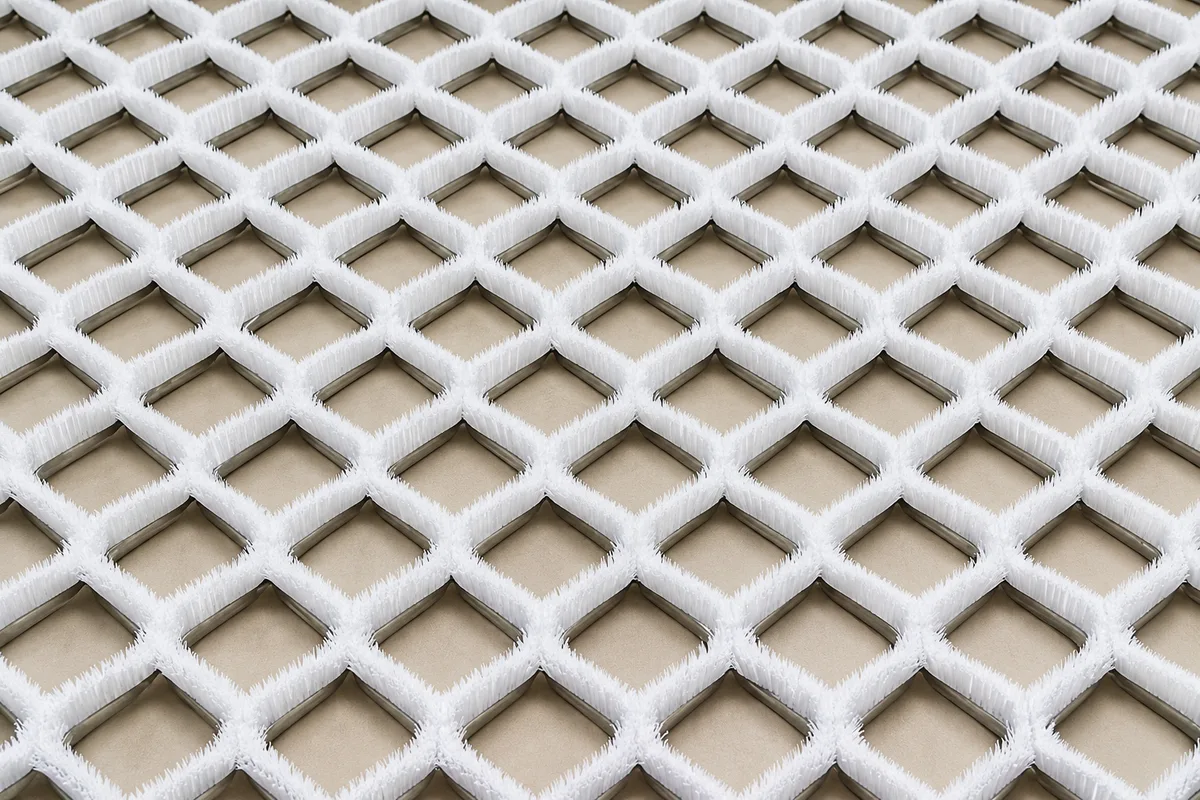
- Mat geometry: finished length and width, diamond openings, formed-channel curves and intersection geometry.
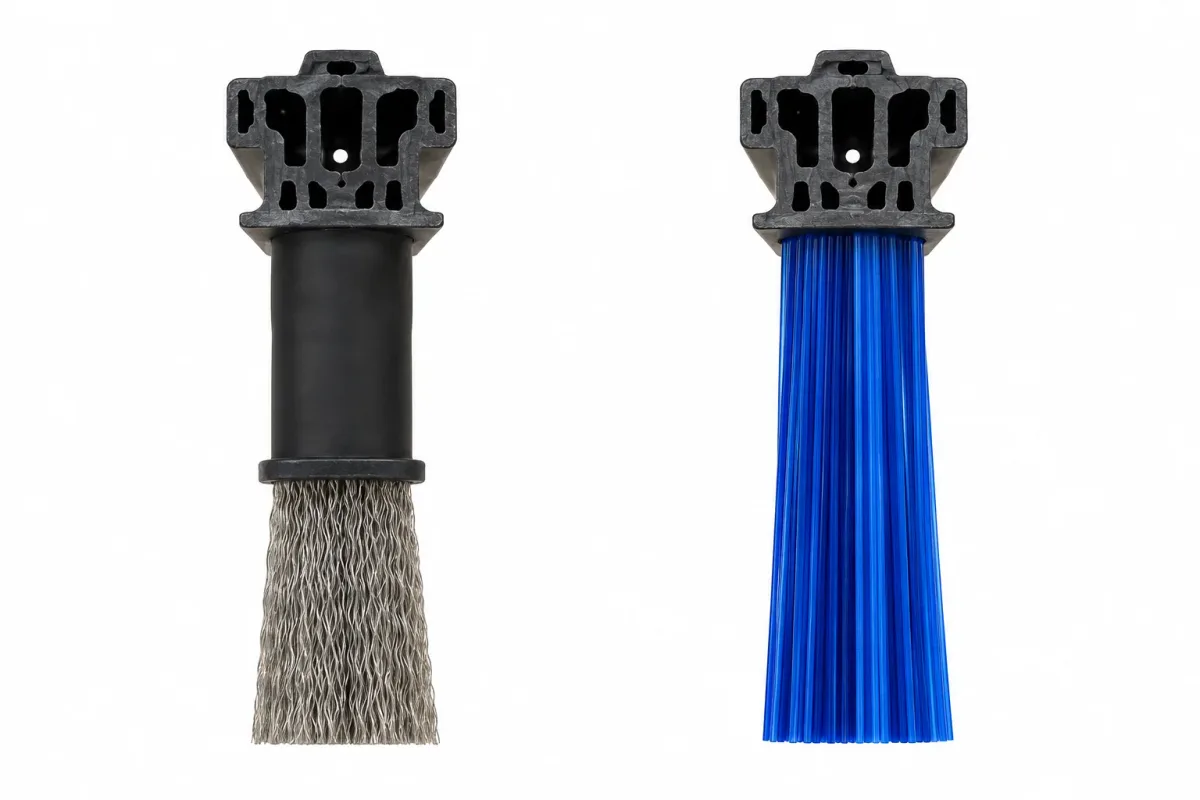
- Brush construction: channel cross-section and material, filament material and diameter, required new trim, density and colour.
- Connections: connection positions and spacing, specified ties or fasteners, and anchoring interfaces.
- Installation: orientation, slope zone, and the adjoining perimeter or transition details.
Similar-looking mats can differ in these features. A dimensional mismatch can accumulate across a repair zone or prevent connection points from lining up.
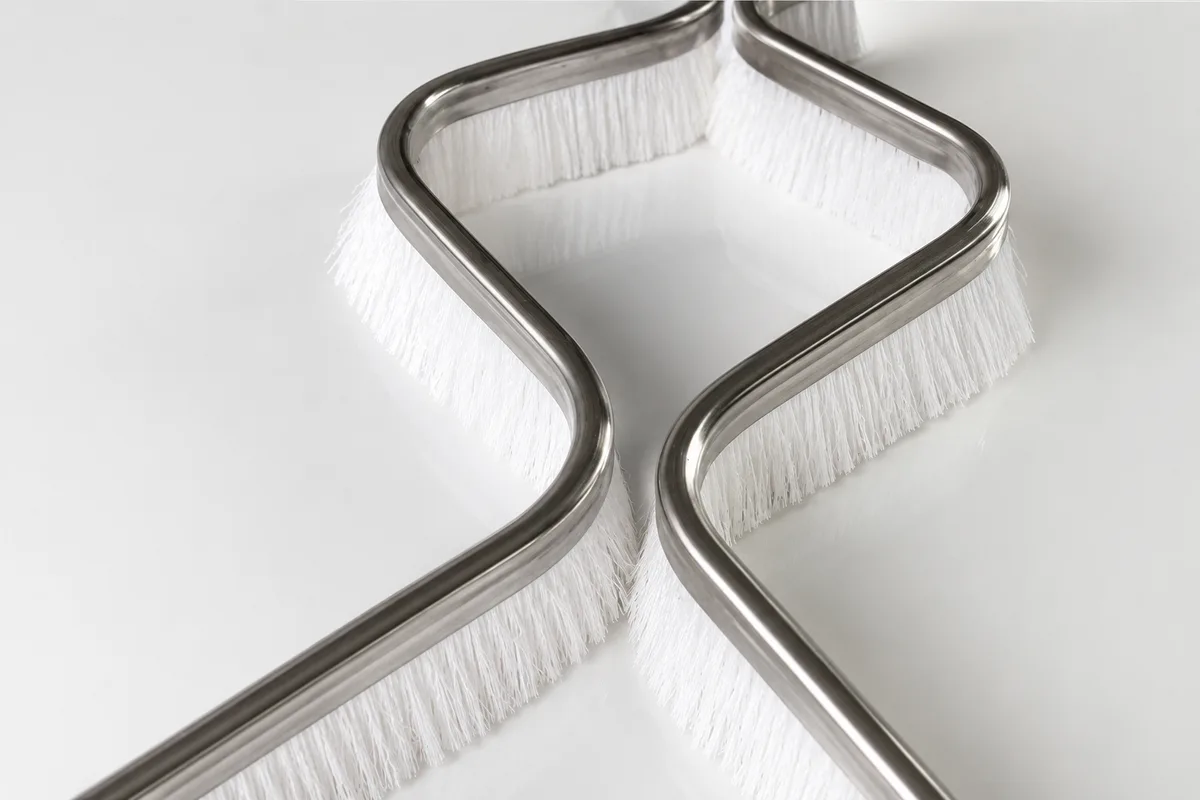
Measure more than one serviceable section. If the original drawing is unavailable, retain a mat in the best available condition as a reference sample and mark its location and orientation. Compare it with other mats and available records to distinguish original dimensions from wear or deformation. Record remaining bristle height separately from the required new trim.
Confirm the manufacturing specification with the customer after resolving these differences. That confirmation does not authorise reopening the repaired slope; the operator must assess the installed repair under the facility’s procedures.
Replacing a Bristle-Mat Section
Slope repair should follow the original surface and facility instructions. Close or isolate the affected area before work begins, and make sure maintenance personnel can work safely on the gradient.
Photograph the repair zone and record the specified connection layout and installation orientation before removal. Do not reuse damaged ties or fasteners. After lifting the section, check the adjoining mats, support layer, drainage and anchoring points, and address any faults before fitting the replacement.
Install the approved replacement without forcing an incompatible module into position. The completed area should lie securely within the existing surface without lifted edges, compressed joints or unplanned gaps.
Use the connection type, spacing, tightening method and anchorage specified for the actual slope system.
How to Check the Repaired Area
Before reopening the area:
- Confirm that every replacement section is connected and secured.
- Check the perimeter and internal transitions for raised edges or gaps.
- Verify that no sharp channel, loose fastener or installation debris remains exposed.
- Confirm that drainage and any installed water or mist system remain unobstructed.
- Compare the replacement area with the surrounding surface for height and stiffness.
- Carry out the facility’s approved controlled-use assessment.
- Reinspect the repair after the initial operating period.
If the new area produces an abrupt change in glide or ski contact, stop the assessment and review the specification, installation and any specified water or lubrication system. Do not rely on the mats to “wear in” before resolving the problem.
Keep Replacement Records
A useful repair record identifies the slope zone, inspection date, observed defect, probable cause, mat specification, replacement batch, connection components and post-installation result.
These records help buyers estimate future spare quantities and determine whether deterioration is isolated or recurring. They also make repeat orders more reliable when the original surface is no longer available.
For larger slopes, keeping approved spare sections from the same production specification can reduce downtime and minimise variation between emergency replacements.
Frequently Asked Questions
How often should dry ski slope bristle mats be inspected?
The HSE recommends checking ski slopes at least daily for damage and debris. The facility may need additional inspections after maintenance, severe weather, unusual loading or a reported surface problem.
How long do dry ski slope bristle mats last?
There is no reliable universal lifetime. Service life depends on the surface construction, skier traffic, slope zone, weather, UV exposure, water or misting, contamination, anchorage and maintenance. Use inspection history rather than a generic number.
Can a different colour be used for a replacement?
Possibly, but colour can identify lanes, boundaries or project requirements. It may also make a local repair visually prominent. Confirm the functional and planning requirements before changing it.
Can an old mat be copied?
A used mat can support a replacement review, but it is a reference until its original dimensions have been established. Check it against drawings, other serviceable sections or supplier records before agreeing what to manufacture.
Is bristle material alone enough to specify the replacement?
No. Material must be combined with filament diameter, trim, density, channel construction, formed geometry and connection layout.
Does Brushcustom install complete dry ski slopes?
Brushcustom’s standard scope is the manufacture of formed strip-brush sections and assembled bristle mats. Slope design, substrate, anchoring, drainage, water systems, installation and facility safety remain subject to the project designer or operator.
Need Replacement Dry Ski Slope Bristle Mats?
For a replacement enquiry, send your available drawing or reference sample, the area to be repaired and the required quantity. We can review the mat and connection details with you before quotation. Our supply scope covers formed brush sections and assembled mats; installation and reopening remain subject to the facility’s procedures.