
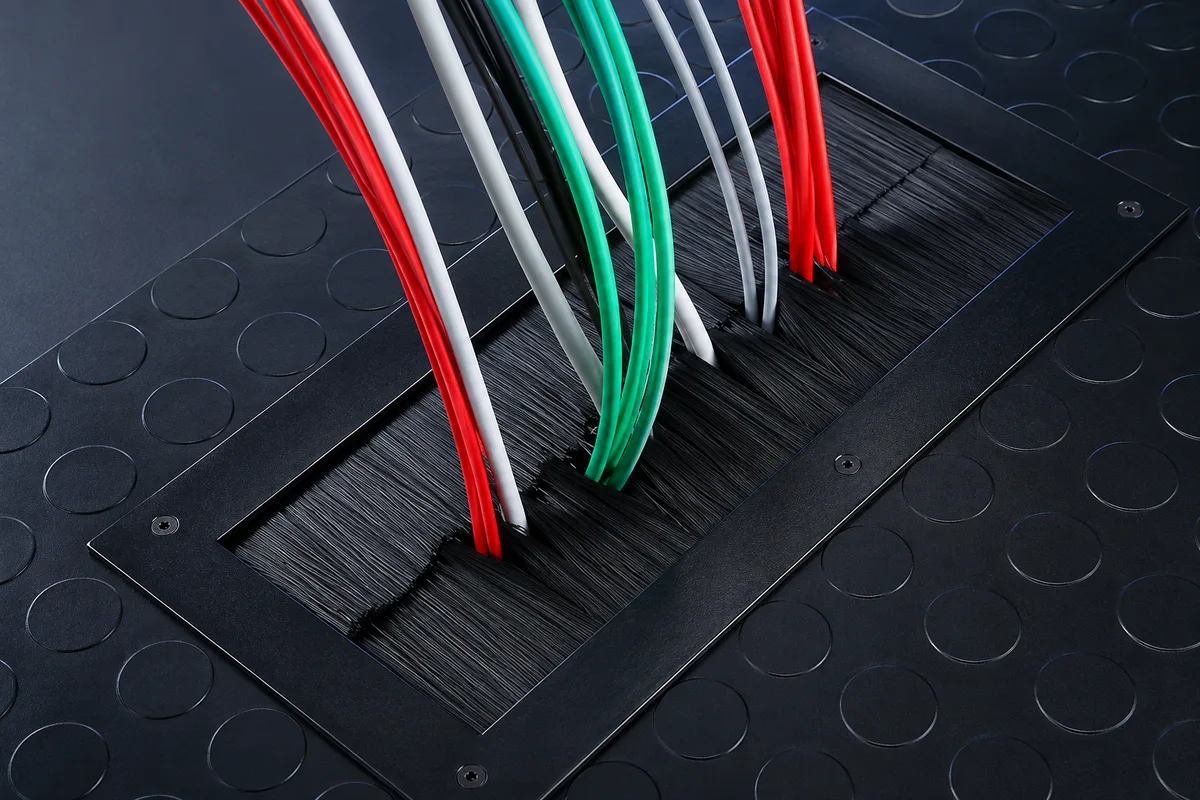
In facilities that route power and network cabling under a raised floor, every bundle that enters a rack, cabinet or PDU passes through a floor cutout — and the unused space around those cables is an uncontrolled air path. These cutouts are among the most common, and most neglected, openings in a data center. A brush grommet covers the cutout while letting cables pass, which is why floor grommets appear in operator installation standards and energy-efficiency guidance alike.
Choosing the right grommet is mostly a question of three things: whether cables are already installed, how the grommet attaches to the tile, and how large the opening is. Split, surface-mount and extended designs answer those three questions — and they are independent choices, not mutually exclusive product families.
Why Raised-Floor Cable Openings Affect Airflow
Many data centers use the void below the raised floor as a supply-air plenum: cooling units deliver conditioned air under the floor, and it reaches IT equipment through perforated tiles placed in front of rack intakes. Any unsealed opening in that floor — a cable cutout, a gap at a wall, a misplaced vented tile — lets conditioned air escape before it does any useful work. This is known as bypass airflow.
The US ENERGY STAR airflow management guidance lists floor grommets among the basic devices that seal around cables where they enter and exit plenums. The same guidance estimates that a single unprotected opening of roughly 12 × 6 inches can bypass enough air to reduce system cooling capacity by about 1 kW. Treat that figure as an order-of-magnitude estimate under specific conditions, not a guaranteed saving per grommet — the actual effect depends on plenum pressure, opening area and the rest of the airflow system. ENERGY STAR’s case material does show real facilities (including a QTS site in Atlanta) installing self-sealing brush grommets as part of airflow programs that measurably improved PUE.
One important condition: not every raised floor is an air plenum. Some designs use the floor void only for cable routing — China’s GB 50174-2017 data center design code, for example, distinguishes floors used solely for cabling from floors that also serve as supply plenums. Where the void carries no supply air, a grommet still provides cable pass-through, edge protection and a finished opening, but it should not be expected to reduce cooling energy.
What Is a Raised Floor Brush Grommet?
A raised floor brush grommet is a framed brush assembly that covers a cable cutout in a floor tile. Cables pass through the brush; the filaments close around the bundle and cover the unused part of the opening. The frame also dresses the raw cut edge of the tile, protecting cable jackets.
When comparing products, it helps to separate three independent dimensions:
- Frame construction — integral (one-piece, drop-in) or split (two-piece, opens around installed cables)
- Mounting method — fitted into the cutout, or surface-mounted over it
- Size class — standard footprints or extended designs for large and long openings
A single product can be, for example, both split and surface-mounted. The sections below look at each dimension in turn.
Integral vs. Split Brush Grommets
The first question is always the same: can the cables be disconnected?
Integral (drop-in) grommets are installed before cabling, typically in new builds. The grommet drops into a defined cutout and cables are later routed through the brush. SEALEZE’s CB10, for example, is a fixed 6.75 × 9.25 inch in-floor grommet that presses into place with no screws or tape, intended for new facilities before power or communications cables are run.
Split grommets solve the retrofit case: the frame opens into two halves, fits around cables that are already connected, and closes over the cutout — installation is possible without disconnecting or re-terminating the cables. Two established examples:
- Chatsworth’s 13671 raised floor grommet uses a split two-piece frame installed along the tile edge, so tiles can be removed without capturing cables. Its rectangular version adds an EPDM flexible membrane between two layers of nylon brush for a tighter seal around bundles.
- Upsite’s KoldLok Split Integral 3030 is designed to seal existing raised-floor cutouts where communications or power cabling is already installed, and likewise allows tiles to be moved without trapping cables.
| Condition | Typical choice | What to confirm |
|---|---|---|
| New build, cables not yet run | Integral / drop-in grommet | Exact cutout size, tile thickness, press-in or fastened fit |
| Live facility, cables connected | Split grommet | Frame opens around the bundle; tile still removable; connector clearance |
Surface-Mount Designs for Existing and Irregular Cutouts
Surface-mount grommets sit on top of the tile and cover the cutout from above. Because they do not rely on a precise cutout fit, they tolerate oversized, off-center or irregular openings — a common situation in older facilities where cutouts were made on site. Upsite’s Surface Mount line (Original 2020, plus Large 2030 and XLarge 2040 versions) is built around this idea: seal a variety of existing tile cutouts while keeping tiles removable and re-cabling straightforward. SEALEZE similarly offers custom surface-mount grommets for oddly shaped holes, with trimmable side profiles described in its product literature.
For a surface-mount selection, check:
- The frame’s coverage footprint versus the actual cutout, including edge condition
- Available flat surface for fastening around the opening
- Whether cables can be routed through the brush without disconnection, if the site is live
Extended Brush Grommets for Large Floor Openings
Some openings are simply too big for a standard footprint — long slots under PDUs, multi-cabinet cable ways, or cutouts that span beyond one tile module. Extended brush grommets address these with elongated brush sections. Upsite’s Extended 6″ × 24″ grommet (part 10013) is compatible with both 24-inch and 600 mm tile systems and can be modified to seal large or unique openings, including those found under PDUs; longer versions such as 3″ × 60″ exist in the same family.
With extended openings, confirm the full opening length and width, fastening points along the long sides, whether the assembly needs to be segmented for handling, and any on-site modification the design allows.
Brush Grommets vs. Rubber Grommets
This comparison is better framed around the job than around a winner:
- Brush grommets suit openings where the cable bundle may change and repeated pass-through is expected. The filaments re-close around cables after every move, add or change.
- Rubber and elastomer grommets or membranes can seal tightly around a defined bundle, but the seal depends on the fit to the actual cables and is disturbed when cables are added or removed.
- Hybrid constructions combine both — Chatsworth’s grommet, for instance, sandwiches an EPDM membrane between two brush layers.
The practical question is not “which seals better” but how often the opening will be re-cabled, and whether the seal must survive those changes without rework.
How to Measure and Specify a Raised Floor Brush Grommet
Whether you are buying a standard product or requesting a custom assembly, the supplier needs the same core information. Start by recording the dimensions below:
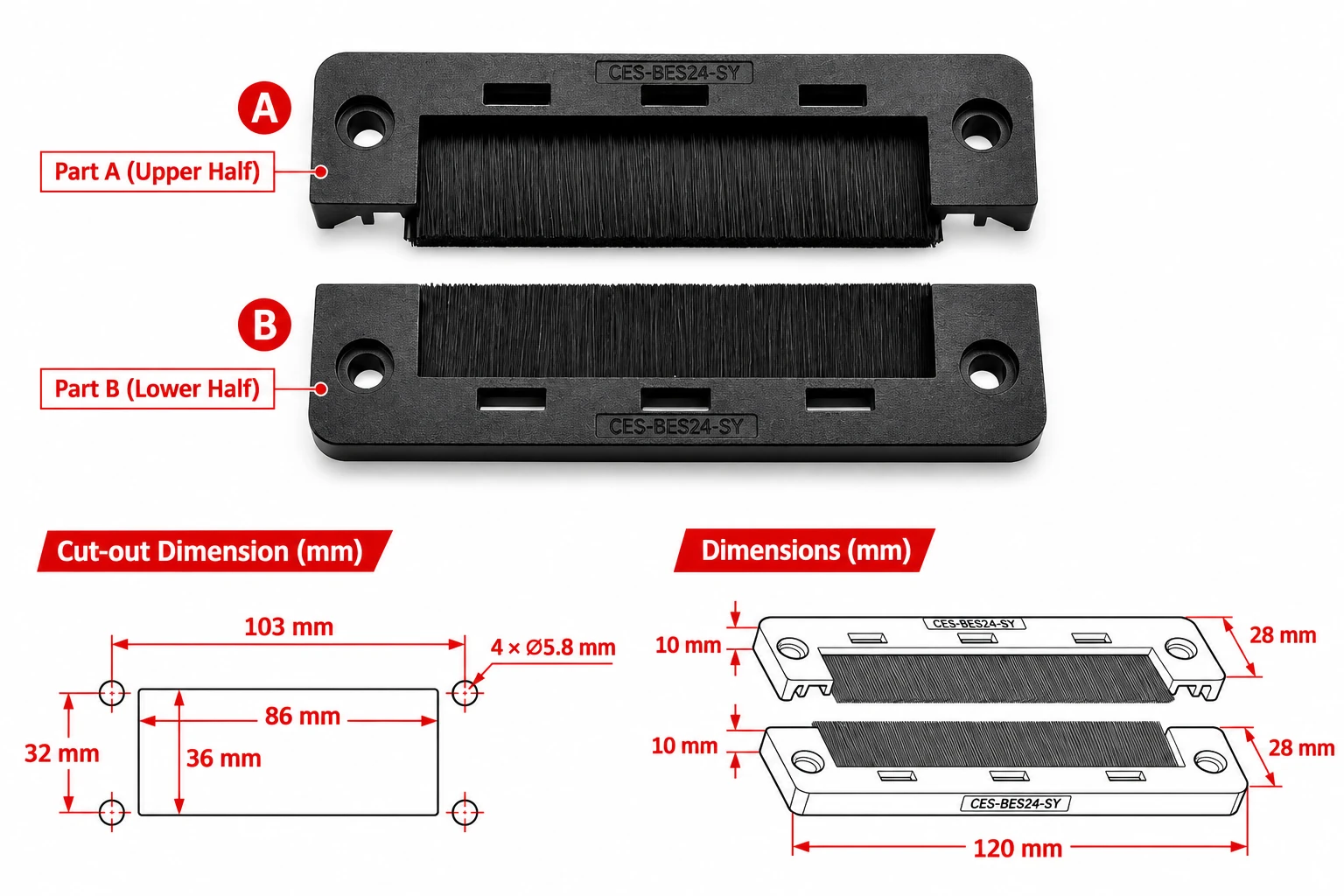
Manufacturer-published examples show how these dimensions relate on real products:
| Product example | Type | Frame / brush size | Recommended cutout |
|---|---|---|---|
| Chatsworth 13671 | Split, drop-in (edge-mount options) | 10.75 × 8.25 in (273 × 210 mm) above floor | 9.25 × 6.75 in (235 × 171 mm) |
| SEALEZE CB10 | Integral, press-in | Fits fixed cutout | 6.75 × 9.25 in (±0.125 in) |
| Upsite KoldLok Extended 10013 | Extended brush module | 6 × 24 in, modifiable | Large or irregular openings, e.g. under PDUs |
These are the cited manufacturers’ published figures, not Brushcustom production specifications — custom sizes are made to drawing.
For a quote, the dimensions shown above are enough to start: send the cutout size, a photo or drawing of the opening, and the quantity — the cable arrangement and mounting details can be confirmed from there.
Two cautions when reading manufacturer data. First, vendor bypass-airflow statistics — such as the “48%” and “60%” figures that appear in different Upsite materials — are averages from specific site measurements, not universal leakage rates and not a promised saving for your facility. Second, a UL 94 HB or V-0 rating is a material flammability classification; it does not make the grommet a firestop system for a rated floor penetration.
Installation and Maintenance Checks
- Confirm the grommet is secure and no gaps remain between frame, brush and tile.
- Check that cables pass through the brush without being forced against a cut edge and remain within their bend-radius limits.
- Verify the tile can still be lifted for underfloor access without trapping cables.
- Follow the tile manufacturer’s requirements for cutting, load rating and support when modifying tiles.
- Reinspect grommets after every cable move, add or change — brush displacement and new gaps are usually introduced during re-cabling, not initial installation.
- Evaluate results with the facility’s normal thermal and pressure monitoring; do not infer a fixed performance value from the product alone.
When Custom Brush Assemblies Are Needed
Standard grommets cover standard cutouts. Custom manufacturing becomes relevant when openings are non-standard or numerous: unusual cutout sizes, round drilled holes in retrofit tiles, tile-edge installations, replacement brush inserts for existing frames, or project-specific frame materials and flame classes.
Brushcustom manufactures split brush grommets in rectangular and round two-piece designs that install around connected cables, plus replacement brush inserts without the outer frame. Send your cutout dimensions, tile details, cable arrangement and quantity for a manufacturing review — or see the broader data center brush applications for rack, cabinet and floor openings.