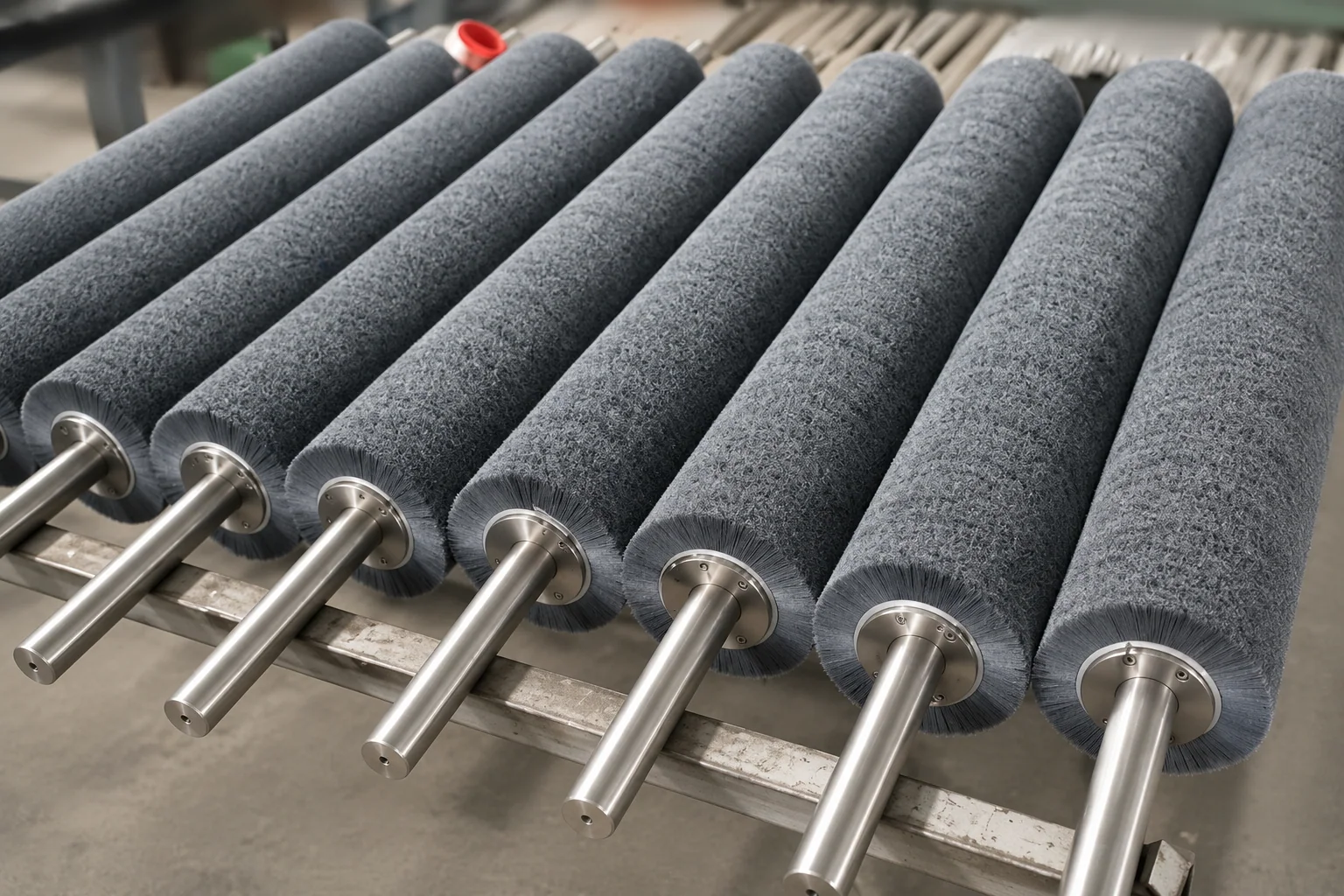
An abrasive filament brush roller rarely fails suddenly. The filaments shorten, the working face changes shape, and the surface result drifts until the machine can no longer compensate for it. At that point there are three different ways back: re-trimming the existing brush face, replacing the worn fill on the original core or shaft, or replacing the complete roller.
These are different services with different costs, lead times and limits. Re-trimming (dressing) restores the working face of the existing fill. Re-bristling — re-filling, re-tufting or rewinding, depending on construction — keeps a serviceable core or shaft and replaces the worn brush body. Complete replacement builds a new roller to drawing. This guide explains how to judge which route fits a worn abrasive filament brush roller, what to inspect before reusing any part of the old roller, and how to verify the refurbished result.
When Is an Abrasive Filament Brush Roller Worn Out?
There is no universal remaining-filament-length limit. The decision depends on the approved finish or burr-removal result, the machine’s adjustment range, and the condition of the retained assembly. Record the original brush diameter and trim, the present diameter at several positions across the face, and the settings at which the last acceptable workpiece was produced. A worn sample alone cannot establish the original dimensions.
As filaments wear, several things change together:
- Outside diameter decreases. Peripheral speed is proportional to diameter at a fixed RPM:
v = πDN/60, withvin metres per second,Din metres andNin revolutions per minute. A 10% decrease in working diameter therefore gives a 10% decrease in calculated surface speed at the same RPM; this does not predict a 10% change in cutting performance. - Remaining trim becomes effectively stiffer. Shorter exposed filament bends less when the filament construction and contact conditions are otherwise comparable. Tanis Brush’s trim-length guidance describes shorter trim as stiffer and longer trim as better at following irregular surfaces. Its wheel-brush operating figures should not be copied to a long industrial roller.
- Contact depth changes if the axis stays fixed. For a flat workpiece, the nominal penetration is the brush radius minus the distance from the shaft centre to the workpiece surface. A 2 mm drop in diameter reduces that nominal penetration by 1 mm. Moving the brush closer can restore penetration within the machine’s adjustment range, but cannot restore lost trim flexibility or missing filaments.
- Conformability decreases. A shortened fill may no longer reach profiles, grooves and edges it once finished correctly.
Some machines adjust brush position as the fill wears. Compensation works only inside the process window: it can recover contact with a smaller diameter, but cannot repair broken filaments, a damaged core or a severely uneven face. Do not raise RPM or pressure simply to compensate for wear without checking the approved operating limits and the finished surface.
Practical signals that the limit is near: the approved finish is no longer achievable at the recorded settings, brush-height adjustment is reaching the end of its travel, burrs or residue remain after brushing, the face shows visibly uneven wear or filament loss, or new vibration appears at operating speed.
What Wear Patterns Can Tell You
Wear pattern is a starting point for inspection, not a diagnosis from appearance alone. Use it to decide what to measure on the roller and the machine.
| Wear pattern | Possible causes | What to check |
|---|---|---|
| Uniform wear across the face | Normal consumption | Remaining trim and the machine’s compensation margin |
| Center wear (middle worn more than edges) | Repeated processing of narrower workpieces, contact distribution, or shaft deflection | Measure the profile across the face; check workpiece width and support arrangement |
| Tapered wear (one end shorter) | Axis misalignment or uneven contact | Compare both ends; inspect machine alignment, bearings and mounting |
| Localized filament loss | Tuft retention failure, local overload | Core and fill attachment at the bare area |
| Melted or glazed filament tips | Frictional heat, interrupted coolant in wet duty | Process settings and coolant supply |
| Permanently deformed fill | Excessive interference, or the brush left pressed against a stopped workpiece | Operating procedure and contact setting |
These patterns are prompts for investigation, not proof of a single cause. Check whether the brush remained loaded against a stopped workpiece, whether coolant delivery was interrupted in a wet process, and whether bearings or guides changed the contact distribution. If the cause sits in the machine or process, a rebuilt or new roller may develop the same defect.
Can Your Brush Roller Be Re-bristled?
Whether re-bristling is possible depends on how the roller was built and whether the retained parts pass inspection. Identify the actual attachment method before removing fill; a label such as “cylinder brush” does not establish that its core can be reused.
| Construction | Typical refurbishment route | What decides feasibility |
|---|---|---|
| Tufted roller (fill set into a drilled core) | Re-tuft only if the core and retention method permit it; otherwise replace the brush body | Core wall and hole condition, cracking, deformation and pull-out acceptance |
| Spiral-wound roller (strip brush wound on a shaft or core) | Remove the worn winding and install a new one where its attachment can be dismantled and remade | Shaft or core condition, strip-retention design and removal method |
| Disc or segment roller | Replace compatible worn sections and retain a serviceable shaft | Section dimensions, spacers, clamping, face profile and balance |
| Sleeve-type roller | Replace the brush sleeve and retain a serviceable shaft | Sleeve fit, shaft and drive features, and replacement availability |
KULLEN-KOTI describes refilling wound-strip and double-band rollers while retaining a suitable shaft. That example supports shaft reuse for those constructions; it does not establish that every tufted or resin-set core can be stripped and filled again. If the existing brush is non-removable, a new sleeve or complete assembly may be more reliable than attempting to salvage the old body.
Not every roller qualifies. A resin-set fill bonded into a damaged core, a cracked plastic tube, or a construction that cannot be stripped without damaging the retained parts may leave complete replacement as the realistic option. Re-trimming is a separate option only when enough usable trim remains to restore the specified face profile and the shorter fill still meets the process requirement.
What to Inspect Before Reusing the Core or Shaft
Refurbishment is not only new filaments. The roller must come back with its geometry and rotating stability restored. Osborn’s roller refurbishment sequence illustrates why shaft, bearing and balance checks precede or accompany re-brushing. The scope for any particular job still has to be agreed against its drawing and machine duty.
Before any core or shaft is reused, check:
- Journals and bearing seats: dimensions and surface condition against the drawing.
- Journal and core runout, plus shaft straightness: measure rigid reference surfaces against the agreed datums. The flexible brush face can deflect under a contact gauge, so its profile needs an appropriate inspection method. A bent shaft must be repaired or replaced before new fill goes on.
- Drive features: keyways, threads, drive collars and end fittings.
- Core condition (tufted rollers): inspect for cracks, deformation and damaged holes; agree how retention of new tufts will be verified.
- Balance-critical parts: end rings and balancing collars complete and serviceable.
Record measurements against the original drawing where available. If no approved drawing survives, agree the reference datums and acceptance limits before quoting repair or reuse. A reusable shaft may still need journal repair or straightening; compare that scope with the cost and lead time of a new shaft.
Re-bristling vs. Complete Replacement: Cost and Downtime
| Check item | Favors re-bristling | Favors complete replacement |
|---|---|---|
| Steel shaft | Dimensions and accuracy acceptable; repairable | Severely deformed beyond economic repair |
| Plastic core | No cracks; suitable for re-tufting | Cracked, aged or badly deformed |
| Tuft holes | Can hold new fill reliably | Holes worn or damaged beyond retention |
| Journals | Acceptable or repairable | Severely worn; repair uneconomical |
| Keyways and mounting features | Intact or repairable | Damaged beyond reliable restoration |
| Brush body construction | Strippable and re-manufacturable | Cannot be removed without destroying the shaft |
| Transport | Local service, or a high-value shaft worth shipping | Cross-border round-trip freight outweighs the saving |
| Timing | Refurbishment lead time fits the shutdown plan | A new roller can be built in advance and swapped directly |
Compare total installed cost and the shutdown plan, not factory prices alone. Estimate both routes on the same basis:
Refurbishment = removal and return freight + stripping + inspection and any shaft repair + new fill + finishing and agreed tests + changeover downtime.
New roller = new assembly + delivery freight + agreed tests + changeover downtime.
For an overseas plant, round-trip transport and the time without a spare can outweigh the value of a small, standard core. A high-value custom steel shaft may justify inspection and reuse, subject to the repair quotation. A new roller can often be built before a planned shutdown; off-site re-bristling normally requires the used assembly to be removed first. Where production continuity matters, compare the cost of keeping a spare roller as well.
Quality Checks After Refurbishment
Agree acceptance criteria before the work starts; do not accept a generic promise of “as new” performance. Inspect the reused parts before covering them, then inspect the finished roller against the approved drawing. Typical checks are:
| Check item | What it confirms |
|---|---|
| Overall diameter | Matches the agreed new-build dimension, not the worn size |
| Working face length | Coverage matches the machine and drawing |
| Filament trim length | Exposed length as specified after final trimming |
| Brush face profile | Uniform, or matching the specified crown or contour |
| Abrasive fill | Agreed mineral, grit designation, filament diameter, trim and fill pattern |
| Fill or segment retention | No loose tufts or sections; verify by the agreed inspection method |
| Journal and core runout | Within the agreed limits at defined rigid reference surfaces |
| Journal dimensions | Fit the bearings and housings |
| Dynamic balancing, where specified | Tested after assembly to the agreed operating condition and acceptance criterion |
| Production trial | Burr or residue removal, surface appearance and any measured roughness within the approved limits on representative workpieces |
Runout and balancing deserve special attention on long or fast rollers. There is no universal runout tolerance or balance grade for refurbished rollers: define the datum, test speed, limits and reporting requirements before production. The production trial should compare a representative workpiece with the approved result; dimensional inspection alone cannot establish brushing performance.
What to Provide for a Refurbishment or Replacement Assessment
You do not need every detail ready for a first inquiry. A useful starting package:
- Photographs: the installed roller, both shaft ends, and close-ups of the worn face showing the wear pattern.
- Drawing or measured dimensions: overall and working-face lengths, diameters, journals and drive features — with worn dimensions clearly marked as worn.
- Construction and fill: tufted, spiral-wound, disc or sleeve construction; the existing filament material and grit if known.
- Machine and operating conditions: make and model, brush position, RPM, wet or dry operation, and the contact setting.
- The problem: what changed in the surface result, and any history of uneven wear, filament loss or vibration.
- Quantity and timing: one roller or a repeat program, and the shutdown window the work must fit.
With this information, Brushcustom can review re-bristling of a serviceable shaft or core, a replacement sleeve or brush body, or a complete new abrasive filament brush roller. Re-trimming may be considered where the remaining fill and equipment permit it; confirm the available service route before relying on it in a shutdown plan. Request a roller assessment with the drawing and photos of the worn assembly.